
Adventures in regenerative living. Permaculture, Natural Farming, Restoration, Forest Gardening, Herbalism, Foraging, Holistic Health
Showing posts with label Forest gardening. Show all posts
Showing posts with label Forest gardening. Show all posts
Monday, July 2, 2018

Thursday, December 14, 2017
We Deserve Beauty: Finding Inspiration in Patterns
“When you put beauty in a place that has none, that's a game changer.”
— Ron Finley
To live in a beautiful, uplifted situation with dignity should not be seen as an exclusive privilege for the elite. It is the birthright of every being born to this earth. The idea that rest of us should content ourselves with stodgy utilitarianism is oppressive. We all deserve beauty.
To surround oneself with beauty is old, powerful magic. It's no wonder it was seen as so revolutionary, so dangerous for Ron Finley to create a beautiful food forest garden in his poor LA neighborhood.
Look! The elk in the wood carries itself with pride, dignity, its chest uplifted, its head and shoulders like a king, its every movement, its very presence is an incantation:
“I AM HERE!”
When we dare to create a beautiful, uplifted environment for ourselves, it allows us to be in the moment boldly, rather than shrink to some sense of shame or inferiority, or worse, an aspirational fantasy of salvation - some savior, the lottery, that promotion, the dream-job, the business breakthrough, the revolution - which may never come.
Instead, we can each make our worlds beautiful and our lives rich. This does not require money. It’s the ultimate taboo of our age, the truth almost everyone wants to hide from you, but you have more power over the way you will experience your daily life than anyone else on this planet does.
The world we want to see starts with us.

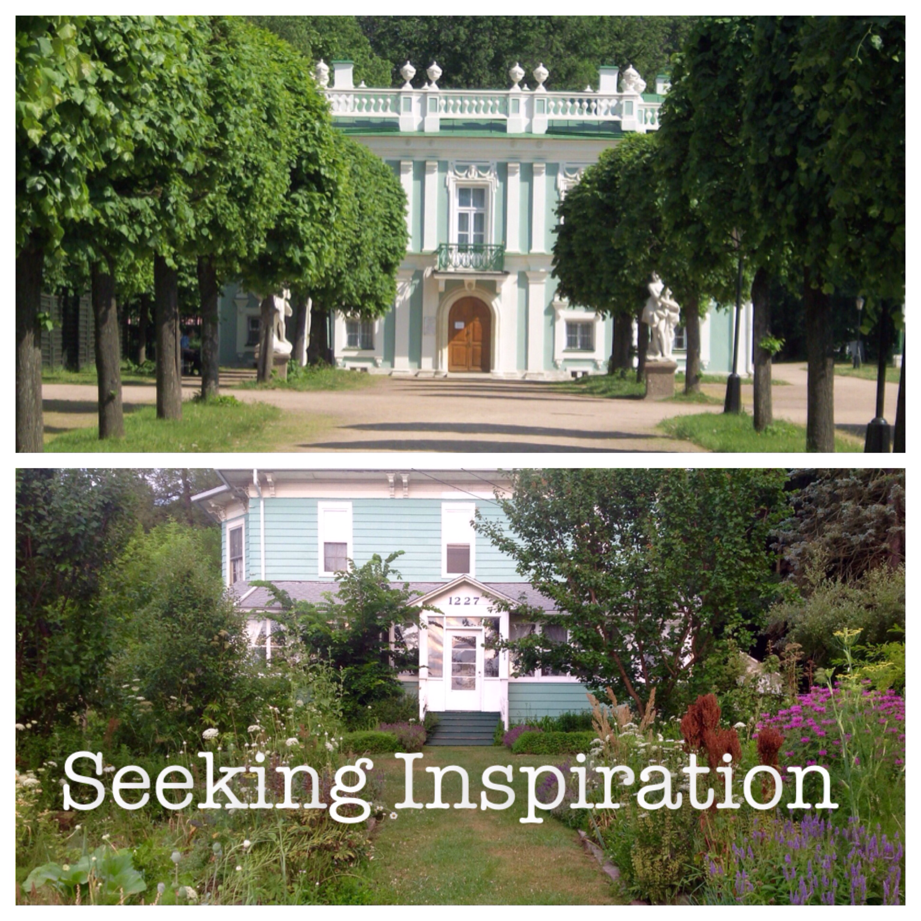
Looking for “patterns” and models to replicate and adapt is both a good tool for improving function as well as creating beauty. This “pattern language” paradigm makes beauty and good design available to anyone, not just those who can afford designers. (See “A Pattern Language” by Christopher Alexander.)
Whenever I approach the teamwork of design, and design is ALWAYS teamwork, I begin by finding patterns that fit the landscape, the architecture, the history, ecology and community character of the space. Each space will be different. What is the "genius of the place" trying to say? How can I help it be heard, rather than stifle its voice under my own song?
These images show just a few of the patterns that inspired our design. The first is the famous “Italian House” at Kuskova. We wanted to invoke this “allee” of trees and hedges framing the entry like a visual mandala setting the mind to a state of focus and attention - visual dharma. And the model was appropriate to the Itaianate design of our home, our climate, our neighborhood and our goal of promoting sustainable living through beauty.

The next is the model of the Jardin de Cure, a historic form of food forest garden. These were beautiful spaces for growing fruit, vegetables, cut flowers, and medicinal herbs while creating a healing, rejuvinating space.

These walking paths along fruiting hedges, with herbs were a natural pattern we could include in our design.

The third example is Highgrove Manor, also somewhat inspired by the jardin de cure. Prince Charles' gardens at highgrove are a model for organic gardening applied to the beauty garden. Most of us do not have the space or resources to have a garden purely for pleasure, we have to integrate herbs, food, and social space into one landscape. But we can still find inspiration in places that work to make people feel GOOD.

Here we see those Jardin de Cure colors in our gardens, with an edible meadow inspired by Highgrove in the background.

More Highgrove colors at Lillie House.

And finally, the most important, inspiring and beautiful pattern we looked to was the "home garden" pattern found throughout the world in indigenous societies. It is the pattern of a just and sustainable society, and one known for its beautiful, life-enhancing environment.
Monday, November 20, 2017
What is Permaculture - A Primer in Pictures and Patterns - PART 1

Is it a community of doomer hippies? An incomprehensible internet meme for do-gooders who hate lawns and love fermenting things? A clever rebranding scheme for the organic farming movement thought up by wayward corporate marketing gurus? A cult for Gaia-worshipping environmentalists? A secret society for foraging herbalist hedgewitches?
WHAT IS PERMACULTURE?

After 6 years, 100 posts, over 100,000 page views, and hundreds of followers, I've never written a post answering that question!
Why?
Because there are already so many good treatments of the topic on the nets. Why re-re-reinvent the wheel when the internet's rolling along just merily without me. Instead, this is an invitation to explore those fine resources, a visual exploration of the common "patterns" that have come to most define Permaculture.
And besides, why author yet another definition when Permaculture creators Bill Mollison and David Holmgren, along with their early-adopter colleagues (especially Rosemarry Morrow) defined Permaculture very eloquently, simply, narrowly and precisely from the start:
Permaculture is a system for designing human habitats (including landscapes, homesteads, homes, towns, cities, organizations and ultimately societies) which starts with ethics and principles, and uses "patterns" derived from natural systems, sustainable societies, and research-based practices. And the guiding GOAL of Permaculture is right in its name: to create "permanent" (sustainable, regenerative) "cultures."
But a great deal of ambiguity and confusion remains. There are many reasons for this. The first is founder Bill Mollison's own penchant for marketing and provocation. While always maintaing a formal definition of Permaculture, he quite often used short, catchy descriptions tailored to the interests of the audience, like:
Permaculture is REVOLUTION disguised as GARDENING.
and
Permaculture is working with nature, instead of against it.
But the ambiguity is also somewhat deserved, as Permaculture has probably become a variety of things beyond its original intent. The word has indeed become a trendy marketing term for all things sustainable, hippie, foodie, and new-age. Many projects and products proudly wear the term "Permaculture" whether they have anything to do with Permaculture design, or its key patterns, or not. This is especially true of farms, although Mollison himself said "the last thing any of us should be doing is any kind of farming!" The relationship between farming and Pemraculture is... complicated.
And Permaculture has also become a community or movement of people interested in all things sustainable, hippie, foodie and new-agey. This often includes conventional farming, natural building, an almost spiritual devotion to "hugelkultures" and rocket stoves, intentional communities, animal husbandry (whether humane or not) and over-alls.
And of course, Permaculture has become a "world-view" if not an outright religion with a clergy, cosmology, commandments, and unquestionable dogmas. Perhaps this was inevitable, since Permaculture can be a mind-blowing perspective shift for many people - one that often inspires the the "cult" in Permaculture (a pun that goes back to Mollison himself.)
As you might have guessed, I'm sometimes ambivalent (if not outright concerned) about these other forms of "Permaculture." Yet, I remain convinced that Permalture Design's primary insight is one of paradigm-shifting importance: that we can use nature-inspired DESIGN to solve our problems, both personal and societal, and create more beautiful, just and sustainable lives and societies.
And because a picture is worth a thousand bon-mots, we'll be visually exploring the patterns that most define Permaculture.
----------------------------------------------------------------------
Permaculture is DESIGN
Whether a landscape, homestead, garden, farm, business, organization, community, or building, a Permaculture site grows along a planned, on-paper design. It doesn't have to be a fancy computer-generated pro design. These are some of the early design sketches for Lillie House.

Permaculture follows ETHICS and PRINCIPLES
The ethics and principles have undergone a series of revisions and drafts, yet remain consistent at their core. One version of the ethics is "Earth care, people care, fair share." There are a veriety of write-ups of the two sets of principles, the Mollison principles, and the Holmgren principles. The Holmgren principles include things like "obtain a yield," "use slow, small solutions," and "Observe and interact." This image is from Permacultureprinciples.com which is the best place to explore and learn about these principles. The site Permacultureprinciples.org has an interpretation of the Mollison principles.

The Permaculture design system uses a process, which begins with observation.
These are some common observation tools used in a design, as applied to our site at Lillie House, including sun angles, precipitation, microclimate patterns, elevation, heat and cold, etc. This is generally the first step in a design process, and is usually taught and required in a Permaculture Design Certificate Course.

Permaculture uses observational tools like Zone and Sector Analysis.
Zone analysis looks at where to place "patterns" and land uses, like gardens, ponds and sheds, by how often you'll need to visit them and how much energy they take to work. Sector analysis looks at "energy flows" that enter and leave the property, like sun, wind, wildlife and traffic, so that we can choose how to deal with them positively. This zone diagram from Toby Hemenway's Gaia's Garden is a classic.

Permaculture Designs place an emphasis on a "Zone 1" kitchen garden.
This most valuable and most productive garden is situated right outside the door, near to the home, where it can be harvested and looked after every day. It is usually an herb garden, a vegetable garden, a fruit orchard and flower garden all in one. Setting up this most important garden that will have the highest productivity and the highest impact on our health is usually the first task in a Permaculture design. Of course, not all sites include kitchens, let alone homes, so not all sites will have a kitchen garden or a zone 1.

Permaculture analyses relative location and interconnectivity
We attempt to make systems look like connected ecosystems, where the needs of each element are met by other elements in the system. The analysis of the chicken has been the standard example since Mollison.

Permaculture stacks functions and connects elements to save work, time and resources.
Understanding the chicken, we can put it to work controlling pests, fertilizing our gardens, turning our compost and heating our greenhouse, all while providing good nutrition, natural habitat, and comfortable shelter to our chicks! This is relationship design going back to Mollison's Permaculture Designer's Manual.

Permaculture designs often resemble indigenous societies, such as the "home garden" pattern found around the world.
The term "home garden" is closely related, and sometimes a synonym for the terms "forest garden" and "food forest." This brilliant diagram is from the study "Home Gardens in Nepal."

Notice how similar that looks to this sketch of a Balkan Ecology Project (Balkep) site. For me, Balkep is one of the most inspiring cutting-edge, research-based Permaculture projects today! It also closely resembles our design at Lillie House.

Permaculture heavily relies on "forage systems"
These are "productive ecologies," largely managed by ecosystem services and the connections between elements in the system. This is the classic visual representation of Permaculture from the Permaculture Design Manual.


Permaculture often makes heavy use of trees and forest gardens
Unless it's otherwise maintained by humans, if an area gets more than 30 inches of precipitation a year, it will naturally become a forest. So "forest gardens" are the natural "forage farming" systems that would be favored on such sites. Also called food forests, edible forest gardens, home gardens, gardens of complete design, forest farms and agriforest systems. These also include a wide variety of traditional systems like the Japanese Satoyama, the European Straubst, hedgerows, copses, panage lots, etc. You can learn more about some of these through our Pin-board on traditional forest garden systems. Forest gardens are not gardening IN a forest, they're gardening LIKE a forest. You can learn more about forest gardens through our links here.

Forest gardening is different from conventional orcharding in that it combines tree crops, vegetables, fuel, craftmaterials, building materials, wildlife habitat, and often social uses all together. They use many layers, instead of just one, and use "hetrogenous" textures instead of rows and even spaces. This image by our colleague and friend, brilliant designer PJ Chmiel, is a master class in one image! You can learn more about the basic defining characteristics of forest gardening from the following video

Permaculture may sometimes use organic gardening, but it is not organic gardening.
This article from PermacultureVisions.com is one of the best I've seen on the topic. In fact, this little gem is another master class in one image, showing us the patterns that really make Permaculture what it is, and something very distinct from conventional organic gardening or farming. In it, we see a designed human habitat integrating energy efficiency, tree crops, fruits, vegetables, wildlife, animals, water-harvesting systems, zones, diverse plantings with no bare soil... all classic features of Permaculture that we'll explore in more depth in Part 2!

Which side do these pictures of our integrated annual vegetable garden beds with tree crops, wildlife habitat, deep mulches, living ground covers, integrated edible companion plants and perennial vegetables resemble?

We'll explore the patterns commonly applied in Permaculture gardens in part 2.

Monday, October 2, 2017
The Caveman Bucket List: 20 Peak Experiences for a Priceless Life

That's just an awful selfie.
I mean, with all of Japan's beautiful architecture and stunning mountain-top views, why would zen master Hakuin, known to have travelled far and wide in his search for enlightenment, choose to depict himself with gramma slippers and a feather duster, seated in his simple zen seat, the place he spent the majority of his day-to-day life? Boring! Everybody knows this image would have earned WAY more likes and follows if he'd struck a pose in front of the Yellow River, panning some duck face and flashing the "shocker." At least put on some sweet new kicks, bro-friend!
Did the poet HanShan exclaim "yolo" as he left civilization for the hermitage on Cold Mountain? Was anyone there to tweet about it if he did?
With all that long-winded poetry about well, just sitting around doing nothing, why didn't the mystic Rumi ever write about what was on his bucket list? Or did he?
And, why did Henry David Thoreau continue to sit around boring Walden pond day-in, day-out, once he'd crossed off #32 build a shack and # 43 grow some beans? - AND written a whole book about it to humble brag to the Concord elite?
These days, everyone is into "Paleo" diets and "caveman" fitness, convinced that we humans evolved to live, eat and exert ourselves in a certain way, and that despite all their backwards lack of airconditioning, our ancestors just might have known SOMETHING about how to be human. Why does nobody ever wonder what was on the Caveman's bucketlist?
Ecologists say each species has its own Environment of Evolutionary Adaptedness, the niche in which they evolved, and in that place, their evolved actions, habits and instincts make sense! But if you remove a species from its EEA, it continues its evolved patterns, but they may no longer fit, and the species may in essence, act insane! Rather than argue over what our most human ancestors ate and drank, why not ask what the cavewoman LIVED FOR and how she LIVED?
For tens of thousands of years (and probably much, much longer) our ancestors went about living their lives, creating memories, discovering untold secrets, having adventures, building life-long deep relationships and romances, busting through personal limits, dancing with gods and goddesses, communing with the raw forces of the universe... often without ever even leaving their own villages. Instead, most of our human cultures marked their lives with journeys into dark, mysterious places, found the empty core of the universe in eachother's souls, deconstructed the very meaning of life and put it back together in the form of something spectacular, achieved stunning magnificience in ritual and rite. Somewhere way back in your family tree was a shaman great, great, great, great grandmother who dreamt of YOU and her fondest wish for your life was that you would learn to feel the heady power of the sacred grove as she did, that over the chasm of great time and distance you and she would resonate in one-ness there together.

These subtle yet profound life experiences our ancestors lived for are all but forgotten today. We ask: If a tree falls in the woods, but nobody posted it to IG, did it really happen? Did all our human ancestors up to the advent of the zipline and iPhone 5 lead dull, meaningless, unfulfilling lives?
Or in contrast, would Henry David Thoreau look upon the jet-setting, world-travelling elite of modern Concord, and still flee their "lives of quiet desperation" in search of his hut in the woods?
In my life I've been privileged to travel further than 99.999% of the humans that ever lived, spoken to people in 9 different languages in their own countries, sold original works of art, music and poetry, played in a punk-rock band, sung Opera on professional stages in Europe, starred in plays (good ones!) and movies (terrible ones!) written 3 novels (yup) slept in a castle, played in a marching band, visited some of the great gardens, art and architecture of the world...
But these are not among the most profound moments, experiences and lessons of my life. Nor do they mean that I have "lived" more than those who haven't had these luxuries. Sure, I've had some profound experiences while visiting exotic places, but the profound parts could have just as likely (probably MORE likely) happened without ever leaving the house. And what one discovers on a real adventure is found inside, and has little to do with the scenery.
None of the following fundamental human experiences require belief, none require drugs, none of it requires meeting the Dalai Lama or attending expensive beach-side retreats in the tropics with world-renown "spiritual teachers." These are not things to be bought at any prices. And these are experiences that are found in all traditions, and are open to anyone, from Christians, to Pagans, to Muslims, to Buddhists, and Atheists. I can fully believe in these fundamental human "spiritual" experiences without having to believe in anything supernatural. In fact, most of the experiences on my list come from "atheistic" spiritual traditions.
Don't get me wrong, I'm not kicking the bucket list idea entirely. At its best, the bucket idea taught a generation of Americans to live their lives, to value experiences over buying stuff, and being adventurers over being consumers. Rad. But at its worst, it makes us into consumers of our own lives, looking to buy experiences, approval and wisdom from others.
So here's a new section for MY bucket: the vital human experience, the Caveman list, aspirations most of our human ancestors likely shared in. I really don't ever need another selfie sipping umbrella drinks on an exotic beach, and neither did Captain Caveman. I want to journey to far darker, more mysterious, more hidden places: the room of the wolf-mother wallpaper, the room where the antler carved the drum... and shit. I've personally visited enough of these places to know that they are real, and well worth the price of admission. But I'm not gonna put a big checkmark next to them to show off, because they're the sort of things you build a truly fulfilling life upon, not the kind you cross off once you've got the bragging rights.
-----------------------------
2. The breakdown of perception of time. Mystics across many traditions wrote about this experience and modern science is confirming the possibility. Some highlight destinations in the travelogues of mystic literature: "to see my own face before my father was born," to spend a "few eternities" as the god of the sea as the Buddha did, and to finally understand that line in Revelations about "a time, times and half a time." Seriously, wtf?
3. Sympathetic joy. To experience the joy of others opens us up to a whole world of joy! Infinite joy! It also defends us from the boring grumpiness of jealousy when our friend gets a promotion. It can even deaden the sting of enmity and hate. But it is also said this deep form of compassion is the basis for experiencing the arts more fully. Imagine feeling what the great painters felt as they put the final touches on their masterpieces? Can you feel whatVonnegut felt when he finally put God Bless you Mister Roosewater to sleep?
4. To co-evolve in my own forest garden. This is another fundamental human experience, intimately connected to spiritual traditions and religious rites in many cultures. It's an amazing thing to grow inside such a system... like "the Doctor and her TARDIS," or Doc Brown and his DIY time machine! I believe, as new evidence suggests, that this is how we evolved, as tenders of the wild, long before we returned to the life and death thrill of the hunt.

5. I am my ecology. My ecology is me. Sacred connection with nature. This is something far more profound than the common new-agey version: "We're all one, we're all like connected, man!" This is an experience born of both insight and deep understanding..
6. The care of magical creatures. One of the lies we tell oureslves in our culture is that "animals" are not the same as us, they do not feel, do not have their own romances and adventures, hopes and dreams. And so we de-vitalize them. It takes a sort of renunciation (renouncing this lie) to begin to see our non-human animals as the vital, living, amazing creatures they actually are. Once we do, we're surrounded by magical creatures more magnificient than anything in Harry Potter.
7. Deep, life-long relationships such as those formed in folk societies and horticultural villages. It would be amazing to share a cup of coffee with a friend over 50 years of time.
8. The Epicurean Life: Self-reliance, living with friends, Contemplation. Epicurus wanted to learn what made the ultimate human life. His bucket list was real simple, yet so profound that ideas about the good life still bear his name today!
9. Getting un-carved: A right view of a simple life as described by Raymond Larose in his Siji-Tsu. In it, he describes the simple, daily life of a daoist sage in his village. Daoists call this simple condition "the Uncarved Block." It is a beautiful, profound take on life. To get up, stretch, breathe, eat while reading a few lines of a book for inspiration, mindfully practice some kind of useful, simple work, take a meal with friends, spend some time in quiet contemplation, walk in the garden....
10. Life in "Dunbar's village." The Dunbar Group researches relationships in horticultural societies and folk villages. They describe the kind of relational landscape humans evolved having and it is again, beautiful, profound and simple. It would be an amazing accomplishment to get to experience that! For most of us, this will mean getting creative about how we engage in village building and community organizing.
11. A life-long path of spiritual development. It's said these tools can be sharpened over a lifetime of use, polished into sublime states of refinement and radiance. What an opportunity!
12. Freedom from possessions. Hard work in the modern age, yet quite a worthy accomplishment! This might take me some time to fully get to. But I hope to work towards this the rest of my life, making a goal to own less, and less and less, to make room in my life for what's really valuable.
13. The freedom of self -reliance. To grow my own food, grow my own medicine, be able to live off the land, to be as trusting and care free as the "lilies of the goddamn field."
14. To stop trying to control the world, to stop "aspiring" to exert "power" over others and over society, and instead lead by example. To fully "let go" into life and "trust" the world. That sentence has a bunch of worlds with a bunch of quotation marks, because our society has all sorts of bad ideas about these things. I've come to think that what I was taught was "power" is actually a complex of delusion, agression and insecurity. "Aspiration" as we use it too often lacks any genuine self-knowledge, which leaves it as nothing more than settling for conformity to a sick society. Finding what it means to "trust" humans in such a sick society is its own challenging quest.
15. Deep trust and true love. Awe, I'm a romantic like that. But I'm also not limited by conventional ideas about what any of that means.
16. The Djanas. These are the states of concentration the word "zen" is derived from, and they've often been compared to mind-blowing orgasm, but timeless and infinite, and subtle. While this word comes from the Buddhist world, one can find similar descriptions of states of deep concentration and contemplation across many of the world's mystic traditions.
17. The outright ecstasy of creative, artistic revelry, to "lose myself" in song and dance. The great experiences of life lie along the extremes of the spectrum of "pleasures subtle and gross." According to the great mystics, it is the experiences at the "sublte" end, found through renunciation, that are the greatest experiences a human is capable of. Such as djana. To experience them, we must quiet the roar of our own minds, our own emotions, our own senses, and even our own senses of our senses. "What am I when I'm no longer here?" But, surely there's something to be said for "gross" bold, hedonistic overwhelming pleasures, too! And at the far end of that spectrum, the mystics, philosophers and poets of the ages place the intense emotional physical experience of losing oneself in song and dance, or revelry.
18. To commit to and follow a culturally relevant spiritual tradition. Tough for a skeptic like me. But I wish to be more than a consumer of spiritual products. I wish to experience that fundamental of following a spiritual path. Many paths lead to the top of the mountain. Only one moon shows in the sky.
19. To eat really, really good just-picked fruit at that magical moment before the sugar starts converting to starch and the complexity of flavor is so profound you literally see technicolor. Or at least I do.
20. Lucid dreaming.
Wednesday, July 12, 2017
The Era of Edible Forest Gardening has Arrived

(Edible Forest Garden at Lillie House, filled with food, flowers and medicinal and culinary herbs.)

Building on the improvements of the "native plants movement," the "wild" landscaping, and then post-wild landscaping paradigms, permaculture-designed forest gardening not only preserves and increases biodiversity, but it also maximizes the potential to create habitat for pressured wildlife, catches, cleans and infiltrates water, dramatically reduces (if not eliminates) our dependence on finite petrochemicals, and sequesters more carbon! Most importantly, it reduces our negative ecological, climate and social impact by helping us grow some of our own food, in the easiest way possible. Moreover, scientists tell us we need to maximize forests if we want to reduce the impacts of climate change. And so the "food forest" has arrived as the new model for the ideal eco-friendly, conscientious landscape design.


(London Glades, photo via the Telegraph)

(London Glades, Telegraph.)

(Aesthetic home forest garden at Lillie House.)

(Jardin de Cure, another traditional European forest garden with ancient origins.)

(Lillie House.)
(London Glades forest garden, which won top honors for future-friendly gardening at the prestigious Hampton Court Flower Show.)


(The famous Pensioner's Garden at the Chelsea Flower Show, top honors, modelled after a traditional English form of forest garden.)

Forest gardening is now widely being called "the oldest human landuse" by academics across many disciplines, with traditional systems across Europe being recognized as important elements of national culture and heritage. But while the western world had largely forgotten these systems, Indigenous communities around the world, especially in the tropics, have kept these systems alive as vital lifelines and important resources. In fact, modern researchers are documenting how these systems allow human societies to harvest the energy of "ecosystem services" in ways that decrease poverty, lessen oppression, mitigate the human impact on wildlife and biodiversity, provide community resilience and autonomy, reduce work hours, and enhance public health (McConnel, Goutum, United Nations, etc.). It was these systems that inspired the first modern Western forest gardens, especially that of Robert Hart.
Slowly at first, starting with the earliest visitors to Robert Hart's forest garden in Shropshire, this most modern/most ancient form of landscape captured people's imaginations: to live surrounded by a landscape of bountiful food, regulated by natural ecosystem services. And then they began to spread like wildfire, with models springing up in cities throughout the western world.
(The famous Pensioner's Garden at the Chelsea Flower Show, top honors, modelled after a traditional English form of forest garden.)
Their influence began to be felt in the world of high landscape design as post-wild, naturalistic landscapers began including more edibles into their work, creating little edible ecosystems that were - in a sense - already forest gardens.
(Food, medicine, comfort, nature...)
Quickly, the idiom became a dominant force in aesthetic garden design with the famous Pensioner's garden at the Chelsea flower show. This now-famous garden, modelled after the traditional "cottage garden" cultural icon - recognized as a form of forest garden integrating food, flowers, teas, medicines together in a half-wild natruralistic planting - stoked the fires of the public imagination world wide.
(Kate Frey, ornamental agro-ecology with fruits like polarded grapes, vegetables, herbs, and flowers.)
The forest gardens kept coming as designers like Kate Frey also took top honors the Chelsea Flower Show, perhaps the world's most prestigious garden competition, with a naturalistic ecosystem of edible plants, wild medicines, and wildlife habitat in a low-maintenance assembly that has been described as an unofficial forest garden. The edible ecological gardens she's gone on to design have been excellent models for what post-wild edible landscaping could achieve in terms of beauty and comfort.
(London Glades, photo via the Telegraph)
And now, the London Glades, an official forest garden, designed with the Permaculture system, has won a gold medal at the Hampton Court Palace flower show, another of the world's most prestigous competitions! And, at first glance, they nailed it! This is a beautiful example of the form. Of course, there's more to a forest garden than beauty, and I would need to look over goals, production objectives, required inputs, desired uses, plant selections and so on, to really know if this is a great forest garden. But, since forest gardens are really about meeting specific needs, and I beleive the primary objective here was beauty, then I think this is a wonderful example. To find out more, view plans and see some mock-ups, visit: http://www.crowdfunder.co.uk/london-glades.
(London Glades, Telegraph.)
The time of forest gardens as an aesthetic medium has come, for any community-minded, conscientous people who want to reconnect with nature while doing one of the single most important things they can do to reduce their negative climate, ecological and social impact. In a world where political solutions seem hard-won and often ephemeral, this is a source of hope, a form of direct cultural transformation we can take action on right outside our door, at our place of work, at an empty lot or bike-trail near our homes....
(Aesthetic home forest garden at Lillie House.)
And finally, a small community of aesthetic-minded gardeners have been working to refine the aesthetics, functionality and comfort of these gardens to move them beyond mere low-maintenance food gardens, but to make models for truly attractive, viable gardens for the home, business or public landscape. Indeed, at Lillie House, we take pride in matching forest garden designs to the architecture, community character and "genii loci" of each place, such as our front yard Jardin de Cure modelled after a historically-acurate style of garden that was popular when our house was built!
(Jardin de Cure, another traditional European forest garden with ancient origins.)
If you would like to visit us here and experience a few different models for what a home forest garden can be like, feel free to send us an email at lillie.house.kzoo@gmail.com or connect with us on Facebook. We have an Introduction to Forest Gardening class coming up on Sunday, August 20th, and may schedule another session for a weeknight around that time.
(Lillie House.)
Friday, April 21, 2017
This Hack Get's Mother Nature to Fight Weeds for You: Fortress Plants

Look: this is a picture of a vegetable at war with the lawn.
Given all the attention around the "food not lawns" movement, you might think I'm being metaphorical. But an experienced gardener will understand that the veggie patch is ALWAYS fighting a war for survival against lawn and "quack grass" greedily trying to take over any bit of land it can get access to.
"I've lost my garden completely to quack grass!!!"is one of the most common tales of garden woe, and usually the only recourse is to completely start over.
But LOOK AGAIN: Here, it is the grass that's on the run! This spunky veg, with no help from the gardener, is actually winning the war. More importantly, this hardy specimen is holding the line, protecting the more easily overrun vegetables behind it. This is what some Permaculturists call a "fortress plant." Best of all, it's perennial vegetable, sorrel, meaning that once it is established it will come back each year, working to keep weeds out of the garden for years to come. This is one of several tools derived from the study of ecology and natural succession that clever gardeners can use to keep grasses and other weeds at bay. But you can't just plant sorrel in your garden and expect not to have any weeds. To work well, we need to understand and apply the ecological principle behind how it works and design with that in mind.

(Another combo of fortress plants that has the grass on the run.)
It wasn't hard to convince myself that pouring a glass of home-grown elderberry-wine sangria and plopping a couple ice cubes in it would be the only possible way to visualize this. Now, staring at that ice cube it's still hard for me to imagine a wall of ice a mile high. But 10,000 years ago, that's what we had right here in parts of Michigan. In fact, as recently as 9,000 years ago most - if not all- of Michigan was under ice. When the ice melted and the water cleared what was left was a blank slate, in ecological terms a "disturbance," ready for mother nature to go to work repairing.
But she couldn't just jump in with the ramps, morels and and solomon's seal that characterize mature woodlands, because they need the rich, deep fungal duff found in the mature forests of Michigan. She had to start with plants that could get a toehold into this "blank slate, with little organic matter or fertility to help out. This gradual process of transformation that occurs after disturbance is called "succession," and that's what we're interested in when it comes to weeds.
Depending on the soil, the ecological history of the site, and other factors, a typical process of succession starts with the small, quick plants that evolved to cover poor "new" soils with little organic matter or easily digestible nutrition, like mosses and lichens. As these die back they enrich the soil with carbon and other nutrients, essentially adding "compost" to the soil and making it accessible to an increasing diversity of organisms. After a while of this composting, grasses and other "pioneer" weeds come in covering the land and playing their role in repairing the disturbance, creating a grassland. Over time, broadleaf plants like dandelions outcompete the grasses, making room for woody perennials to move in, creating a shrub field, then a savannah, then an open woodland, and finally coming to "climax" at a dark, dense mature forest.

(A forest edge imitates this process, gradually advancing on the grassland.)
So, to nature, "weeds" grasses, and even non-native grasses have a role in ecosystems and a place in the process of ecological succession. In a natural system, their time is fleeting, doing their job, then slowly phasing out of dominance, eventually becoming rare in landscapes they had once dominated as they are replaced by the species that evolved to succeed them. This is why there are rarely many grasses or dandelions in a mature forest, and when they're present they are in balance, not dominating the other plants.

But in a conventional garden we're constantly setting the ecological clock back every time we till or weed the garden, recreating the "disturbance" that is the promised land of the very grasses and pioneer "weeds" we're trying to get rid of! This is a system designed to fail!
From a Permaculture approach, a better way to keep grasses and other "weeds" from taking over the garden is imitate the process of succession. Author Toby Hemenway called this "fast forwarding to a later stage of succession" beyond the stage where these "weeds" necessarily reign.
As it turns out, this "mid-succession" state, where grasses and early pioneers have started to naturally cede territory to a greater diversity of herbaceous plants, woody shrubs and early pioneer trees, is the ideal natural habitat for most of our favorite food plants. The soil is rich with organic matter and fertility. A variety of sun-shade habitats provides niches for many plants. Most (but not all) of our veggies can easily find a home in such an ecosystem, and most of our fruit trees are mid pioneers, happiest in such a situation. In nature, this situation is found at the forest edge, where the forest is spreading out converting grassland, and in old-fields and savannah systems.
This is one reason why a well-designed forest garden works so well: it creates a variety of habitats all hovering somewhere around this mid-succession sweet spot.

(An agro-ecosystem that imitates the mid-succession sweet spot.)
And Fortress Plants are just one great hack that food and ornamental gardeners alike can use to tap into this process.
The term "Fortress Plant" is not an ecological term, but rather a handy catch phrase for the various mid-succession pioneers that are adapted to reach out into grassland and begin converting it to forest, through competition, shade and allelopathy (chemicals secreted by one plant to poison its competition.)
So one fortress specimen alone will almost certainly be overrun. But if we can plant these perennial pioneers together with enough density to mimic the spreading pattern of succession, we have a chance at making a garden that is fairly resistant to grass and weed pressures, yet provides ideal habitat to our favorite fruits and veggies.

(An edible hedgerow on the march, converting grassland just like a natural forest edge.)
A final caveat is that different soils require different fortress plant communities, so this strategy takes some experimentation. My recommendation is to use high diversity and high density, giving nature the tools she needs to solve the problem on the soils at hand.
Starter List of Recommended Potential Fortress Plants
Relatively Low Herbaceous Perennials Idea for the Garden Edges
Most woody perennial herbs, depending on soil (better on sandy soil.)
comfrey, pretty much everywhere
sorrel and blood-veined sorrel
turkish rocket
cardoon
most spring ephemeral bulbs including daffodils and alliums (though the effect is stronger at greater densities and with other plants)
over-wintering annual ephemerals like chickweed, dead-nettle, wild mustards and wild cresses
the monardas
fennel (again, this is probably a weeker effect on most sites, but it has good research proving its allelopathic influence.)
Taller Fortress Plants Often Observed at the Edges of a Forest
pokeweed
sunchokes
Maximillian sunflower
lovage
cane fruit
And this is just one of many tools that gardeners and farmers can use to put the process of ecological succession to work for them. The strategy gets even better when combined with other succession-mimicking hacks, like "nurse logs," another research-based approach to fast-forwarding succession. At Lillie House, these three factors are often seen working together.
To get a fuller understanding of what these ecological mechanisms are and how they can easily be applied in the garden, we hope you'll join us for this year's Complete Forest Gardening Course, where you can see how these patterns are applied and managed over the course of a growing season, here at lillie House.

Wednesday, March 30, 2016
Community Supported Forest Gardening Program!!!

It also comes with complete access to our entire HUGE collection of perennial edibles, self-sowing vegetables and ideal forest garden plants. I'm especially proud of the course we put together for this program - it's going to be a great time, a great learning experience, and we're going to create some great forest gardens in the process.
Mike
Subscribe to:
Posts (Atom)