Showing posts with label s.w. michigan. Show all posts

Thursday, May 31, 2018

Gardening Against Climate Change - 10 Tips and Techniques


"You can solve all the world's problems in a garden." 
- Geoff Lawton, The Permaculture Research Institute

RELATED VIDEO: Permaculture ideas for positive direct action!

Hot enough for ya? If not, just wait: According to NASA 2014, 2015, and 2016 were each consecutively the hottest years on record globally, and 2017 was the hottest year on record without an El Nino, coming in second after 2016. Already, 2018 is looking like it will be a contender. 

This next couple of paragraphs are the bummer part, so first: LOOK! A BUNNY!


Of course, it would be nice if heat was the only problem. But no, the real problems caused by climate change will be ecosystem collapse, breakdown of the farming and food systems, increased disease and human health impacts, larger storms, more wildfires, potentially increased earthquakes and volcanic activity from ice melts, sea-level rise, refugee migrations caused by famine, drought, and flooding, and a whole host of secondary and tertiary affects that will be felt first and most profoundly by the globally disadvantaged. And, as researchers get a better picture of what our climate future will look like, they're increasingly predicting the most dire scenarios, unless bold dramatic action is taken immediately. Many researchers are now talking seriously of predictions of dire civilization-shaking consequences as early as 2030. 

But for those of us who garden, we don't need NASA to tell us climate change is in full swing. In my biome of S.W. Michigan, an unusually brutal winter of temperature fluctuations between hot and cold left plants and ecologies reeling, then record flooding, followed by Spring starting a month late, and then going straight into more 90 degree days here than we typically average in a whole summer - and it's not yet June! Meanwhile, gardening and farming fora are filled with posts about increased pest problems, and scientific journals and extensions are noting climate-related spread of new pests each season. Others are widely reporting plagues of mosquitos and ticks. While it's hard to directly blame the whole of this on climate change, all of this is exactly the sort of thing predicted to result from climate change. 

Meanwhile, political solutions don't seem forthcoming. The best chance we have is the Paris accord, which doesn't remotely go far enough to prevent the worst-case scenarios from still occurring, and places what even this environmentalist has to acknowledge are unrealistic and likely impossible burdens on the US. 

However, there is good news. We each have the potential to respond in a way that is powerful and life-enhancing. 

And there is still hope - if we stop waiting for politicians and start taking direct action. 

While many poo poo the possibility of direct action, hoping instead to channel energy into their political candidate or cause, we know a few things for certain: 

1. The consumer economy is driving the greenhouse gas emissions that cause climate change. 
2. When the consumer economy falters, greenhouse gasses go down. 

And 3, as "industry murdering" Millennials have proven time and time again, consumption choices are powerful and can have a direct effect on stunting and crashing corporations and industries. 


And to the extent that it is itself sustainable, and it effects our spending and the spending of others, what we do in the garden can be a truly powerful, multi-pronged way to meaningfully address climate change. 

As a mode of climate resistance, gardening offers two main benefits:

Resistance & Resilience

First, a garden offers us a meaningful way to act against climate change and the host of other negatives associated with "public/private" fascism. We'll start by talking about the mechanisms, then we'll get into the methods we can each use to make our home gardens, farms and public landscapes more effective tools in fighting climate change!

Resistance

1. Starve the beast. As stated above, the 1 million articles about Millenials killing industries proves that our consumer choices DO have a powerful impact. And Permaculture co-founder David Holmgren dug into the numbers to demonstrate that it is indeed possible to mitigate or even reverse climate change via consumption changes alone. But let's be clear, not every garden is a climate-fighting endeavor. Some gardens are demonstrably worse than driving a Hummer! The change we need to make to be effective is to replace consumption of corporate food and materials with those grown sustainably closer to home. 


2. Reduce, reuse recycle. These are still powerful modes of reducing consumption and thus greenhouse gas emissions. Gardens give us a chance to do all three, through growing food, providing recreation at home, repurposing household items into garden-wares, and mulching and composting.

3. Protect wildlife habitat and biodiversity. One of the biggest problems with climate change is that it will further contribute to the ongoing mass extinction event underway. It's extremely powerful for us to use our landscapes to provide a sanctuary for wildlife, insects, and endangered plants. Again, not every garden does this. In fact, many gardens are war zones against biodiversity!

4, Sequestering carbon. A garden can be designed to actually directly fight climate change by sequestering carbon in the soil and in plant tissues. 

5. Catching and infiltrating water. Another indirect effect of climate change is that it will contribute to further depleting our aquifers. While many gardens waste water for irrigation and fancy ornamental water features, gardens CAN be designed to catch water and get it back into the aquifer.  

6. A garden CAN reduce our burden on the food system, which will be increasingly fragile as climate change continues. 

7. Decrease suffering for as many as possible, and increase happiness for as many as possible, for as long as possible. Even if we can't stop climate change, we can use our gardens as a sanctuary habitat for humans and non-humans alike, and model for others how to better thrive in challenging times, because gardens can be important sources of resilience.

Resilience

1. Moderate climate around the home, providing cool in summer, warmth in the winter, and shelter in increasingly harsh storms. 
2. Help us withstand shocks to the food and water system. 
3. Provide recreation and stress relief during times of stress and disruption.
4. Help us to grow social capital and community cohesiveness. 

Tips and Techniques:

But in these regards, not all gardens are created equal. In fact, some may actually achieve quite the opposite effect. So here are some tips and techniques we've used and recommend to make our gardens into powerhouses of climate change resistance and resilience: 

1. Grow food. Even in ornamental landscapes. Because our food system is arguably the #1 cause of climate change, and our traditional landscapes (especially lawns) are another major driver, using food plants to reform our landscape strikes to the core of climate change. While any garden that reduces lawn is likely a step in the right direction, and native plant gardens may provide increased biodiversity, a food garden reduces our consumption and reliance on the systems that are the leading cause of climate change. This does not necessarily mean having a traditional "food garden," which may actually deplete soil carbon, waste fertilizer and fossil fuels, and reduce biodiversity, but a well designed garden that integrates food plants can be especially powerful. Perennial edibles and no-till systems are two great ways to improve garden sustainability and performance. Perennial systems like edible hedgerows, edible prairies, coppices, and forest gardens may be the easiest and most climate-positive forms of garden we can grow. Every landscape should include some of these!


2. Grow fertility, healthy soil, and simultaneously sequester carbon. If we want to get serious about sequestering carbon, we need to have a plan to stop importing fertility and start growing it on site. When we import fertilizers, we're depleting non-renewable resources, and when we import compost, we're depleting carbon from someplace else, while adding to greenhouse gas pollution via shipping. Growing our own fertility ensures that we're actually sequestering carbon, reducing our overall greenhouse gas footprint, and our healthy soils will help take better care of our crops. A few key ways to grow fertility include: deep mulch gardening with home-grown mulch-maker plants, perennial fertility strips, edible hedgerows and other agroforestry systems, nitrogen fixing plants, and wetland or water gardens. Everyone should be composting, and some of the easiest methods for home-owners include sheet-composting, and trench composting, which do not require maintaining a pile or carting compost around the yard.  Grow Bio-intensive is a method based on growing fertility using annual crops in the garden. 

3. Grow some native plants. Native plants may provide better wildlife habitat and protect biodiversity, which research shows will increase the health of your garden and crop plants. This does not mean that your grandpa's daylilies or your aunt Petunia's petunias have to go, or that you've got to ditch the tomatoes. There's no proven benefit to growing ONLY native plants, but there are proven benefits to including them. In fact, because climates and soils have changed, in many regions "native" plants may be more difficult to grow in our modern non-native soils and climates, which may require measures that waste resources, pollute carbon and harm ecosystem biodiversity.  Many native-only gardens also leave the human inhabitants reliant on the destructive food system. Meanwhile, some of the best native plants to grow are edible, and some of the best fruits and vegetables are natives! In my region, that includes paw paws, persimmons, currants, jersusalem artichokes, varieties of alliums, and many, many others. 

4. Include wildlife habitat like rockeries, wood piles, unmown grasses, and messy garden areas. These will increase biodiversity, protect climate-threated wildlife, and attract beneficial organisms that help keep the garden healthy. 

5. Have a design to catch and store the water on your site and use it wisely. Permaculture design is a great resources, since it starts with treating water as a "mainframe element" and teaches that we have an ethical obligation to constructively treat the water that falls on our properties. This also includes a plan for water-wise gardening, so that we can be responsible in how we use water, too. I recommend Toby Hemenway's 5-fold water wise gardening plan, as described in Gaia's Garden.


(Water designs at L.H.)

6. Use recycled materials in the garden whenever possible, instead of buying new. 

7. Avoid manufactured concrete, cement, and faux brick landscaping products, as the concrete industry is one of the leading causes of carbon pollution, and shipping further contributes to the footprint. In fact, concrete is so unsustainable, that it needed its own number. Recycled concrete, or "urbanite," can be both aesthetically and ethically beautiful. 
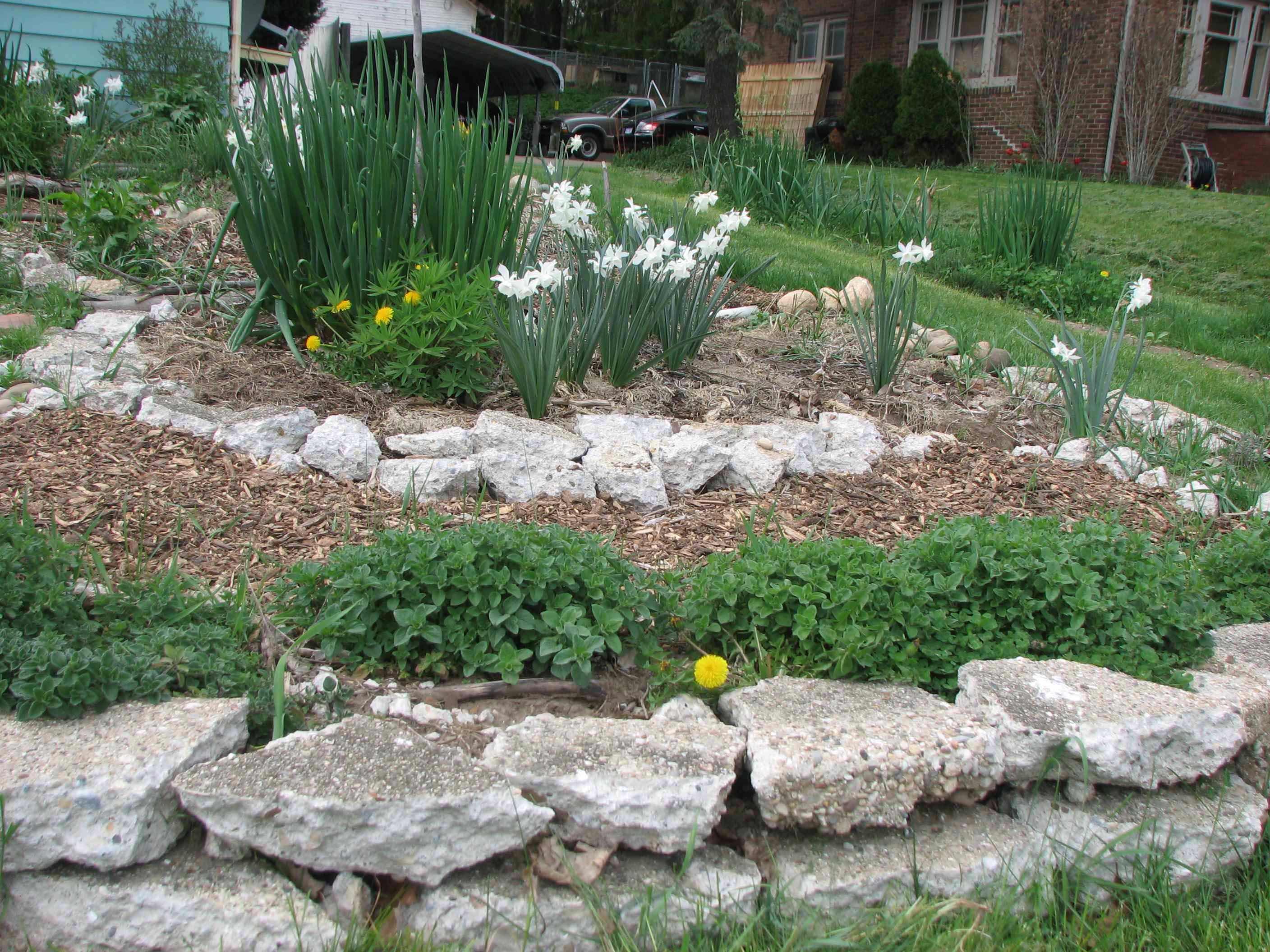

8. Avoid the use of plastic materials and plastic landscape fabrics. Not only do these contribute to climate change in their manufacture and shipping process, they also are quickly becoming the leading cause of plastic pollution of water and soil. Plastic in food production systems has been found to contaminate food at unhealthy levels. 

9. Start exploring no-till gardening. This won't necessarily work for every crop, or every ornamental in every garden or landscape. However, there ARE plenty of crops that will actually grow better and with less labor and cost, when grown in no-till systems. You might not be able to replace the entire farm or garden with no-till right away, but you might be able to start saving time, and soil carbon, by figuring out how and where no-till will work for you. 

10. Utilize the power of biodiversity, Biodiversity will increase the health and resilience of your plants, while also assisting wildlife and threatened plants. Having a variety of crops will mean you're protected against crop losses, pest issues and extreme weather events in a changing climate. Again, perennial edibles and perennial systems like hedgerows and forest gardens may be the superstars of a climate resilient garden, as they build up energy and store it over many years, and have deep roots to pump water, they may be less susceptible to all forms of extreme weather. 

So, that is our checklist of tips and techniques to make the most of the climate-resistance garden. Am I missing anything? What steps are you taking? Leave a comment below, or share on social media by visiting us on Facebook. 

------------------------------------

If you would like to learn more about climate resistance gardening, water harvesting, no-till gardening, growing fertility, perennial vegetables and growing systems, or see these techniques in action, consider joining us for this special event. We'll be offering this event twice this summer, on June 7th, from 2:30 pm - 5, and again on August 11th from 9:00am - noon. 

Suggested donation: $20. @ Lillie House. To learn more or reserve your space, visit: https://squareup.com/store/lillie-house-permaculture/item/gardening-against-climate-change-intro-to-permaculture


Friday, April 21, 2017

This Hack Get's Mother Nature to Fight Weeds for You: Fortress Plants


Look: this is a picture of a vegetable at war with the lawn. 

Given all the attention around the "food not lawns" movement, you might think I'm being metaphorical. But an experienced gardener will understand that the veggie patch is ALWAYS fighting a war for survival against lawn and "quack grass" greedily trying to take over any bit of land it can get access to. 

"I've lost my garden completely to quack grass!!!"is one of the most common tales of garden woe, and usually the only recourse is to completely start over. 

But LOOK AGAIN: Here, it is the grass that's on the run! This spunky veg, with no help from the gardener, is actually winning the war. More importantly, this hardy specimen is holding the line, protecting the more easily overrun vegetables behind it. This is what some Permaculturists call a "fortress plant." Best of all, it's perennial vegetable, sorrel, meaning that once it is established it will come back each year, working to keep weeds out of the garden for years to come. This is one of several tools derived from the study of ecology and natural succession that clever gardeners can use to keep grasses and other weeds at bay. But you can't just plant sorrel in your garden and expect not to have any weeds. To work well, we need to understand and apply the ecological principle behind how it works and design with that in mind. 

 
(Another combo of fortress plants that has the grass on the run.)

It wasn't hard to convince myself that pouring a glass of home-grown elderberry-wine sangria and plopping a couple ice cubes in it would be the only possible way to visualize this. Now, staring at that ice cube it's still hard for me to imagine a wall of ice a mile high. But 10,000 years ago, that's what we had right here in parts of Michigan. In fact, as recently as 9,000 years ago most - if not all- of Michigan was under ice. When the ice melted and the water cleared what was left was a blank slate, in ecological terms a "disturbance," ready for mother nature to go to work repairing. 

But she couldn't just jump in with the ramps, morels and and solomon's seal that characterize mature woodlands, because they need the rich, deep fungal duff found in the mature forests of Michigan. She had to start with plants that could get a toehold into this "blank slate, with little organic matter or fertility to help out. This gradual process of transformation that occurs after disturbance is called "succession," and that's what we're interested in when it comes to weeds. 

Depending on the soil, the ecological history of the site, and other factors, a typical process of succession starts with the small, quick plants that evolved to cover poor "new" soils with little organic matter or easily digestible nutrition, like mosses and lichens. As these die back they enrich the soil with carbon and other nutrients, essentially adding "compost" to the soil and making it accessible to an increasing diversity of organisms. After a while of this composting, grasses and other "pioneer" weeds come in covering the land and playing their role in repairing the disturbance, creating a grassland. Over time, broadleaf plants like dandelions outcompete the grasses, making room for woody perennials to move in, creating a shrub field, then a savannah, then an open woodland, and finally coming to "climax" at a dark, dense mature forest. 

 
(A forest edge imitates this process, gradually advancing on the grassland.)

So, to nature, "weeds" grasses, and even non-native grasses have a role in ecosystems and a place in the process of ecological succession. In a natural system, their time is fleeting, doing their job, then slowly phasing out of dominance, eventually becoming rare in landscapes they had once dominated as they are replaced by the species that evolved to succeed them. This is why there are rarely many grasses or dandelions in a mature forest, and when they're present they are in balance, not dominating the other plants. 


But in a conventional garden we're constantly setting the ecological clock back every time we till or weed the garden, recreating the "disturbance" that is the promised land of the very grasses and pioneer "weeds" we're trying to get rid of! This is a system designed to fail!

From a Permaculture approach, a better way to keep grasses and other "weeds" from taking over the garden is imitate the process of succession. Author Toby Hemenway called this "fast forwarding to a later stage of succession" beyond the stage where these "weeds" necessarily reign. 

As it turns out, this "mid-succession" state, where grasses and early pioneers have started to naturally cede territory to a greater diversity of herbaceous plants, woody shrubs and early pioneer trees, is the ideal natural habitat for most of our favorite food plants. The soil is rich with organic matter and fertility. A variety of sun-shade habitats provides niches for many plants. Most (but not all) of our veggies can easily find a home in such an ecosystem, and most of our fruit trees are mid pioneers, happiest in such a situation. In nature, this situation is found at the forest edge, where the forest is spreading out converting grassland, and in old-fields and savannah systems. 

This is one reason why a well-designed forest garden works so well: it creates a variety of habitats all hovering somewhere around this mid-succession sweet spot. 

 
(An agro-ecosystem that imitates the mid-succession sweet spot.)

And Fortress Plants are just one great hack that food and ornamental gardeners alike can use to tap into this process. 

 The term "Fortress Plant" is not an ecological term, but rather a handy catch phrase for the various mid-succession pioneers that are adapted to reach out into grassland and begin converting it to forest, through competition, shade and allelopathy (chemicals secreted by one plant to poison its competition.)

So one fortress specimen alone will almost certainly be overrun. But if we can plant these perennial pioneers together with enough density to mimic the spreading pattern of succession, we have a chance at making a garden that is fairly resistant to grass and weed pressures, yet provides ideal habitat to our favorite fruits and veggies. 

 
(An edible hedgerow on the march, converting grassland just like a natural forest edge.)

A final caveat is that different soils require different fortress plant communities, so this strategy takes some experimentation. My recommendation is to use high diversity and high density, giving nature the tools she needs to solve the problem on the soils at hand. 

Starter List of Recommended Potential Fortress Plants

Relatively Low Herbaceous Perennials Idea for the Garden Edges
Most woody perennial herbs, depending on soil (better on sandy soil.)
comfrey, pretty much everywhere
sorrel and blood-veined sorrel
turkish rocket
cardoon
most spring ephemeral bulbs including daffodils and alliums (though the effect is stronger at greater densities and with other plants)
over-wintering annual ephemerals like chickweed, dead-nettle, wild mustards and wild cresses
the monardas
fennel (again, this is probably a weeker effect on most sites, but it has good research proving its allelopathic influence.)

Taller Fortress Plants Often Observed at the Edges of a Forest
pokeweed
sunchokes
Maximillian sunflower
lovage
cane fruit

And this is just one of many tools that gardeners and farmers can use to put the process of ecological succession to work for them. The strategy gets even better when combined with other succession-mimicking hacks, like "nurse logs," another research-based approach to fast-forwarding succession. At Lillie House, these three factors are often seen working together. 

To get a fuller understanding of what these ecological mechanisms are and how they can easily be applied in the garden, we hope you'll join us for this year's Complete Forest Gardening Course, where you can see how these patterns are applied and managed over the course of a growing season, here at lillie House. 


Friday, April 22, 2016

Selecting Trees for a Forest Garden: What to plant and How Many


These days, the "new" wisdom is that - 100, 400, 1,000 - "you can't plant too many fruit trees!"

Not surprisingly, this advice most often gets repeated by nursery businesses that sell fruit trees. And as a guy with a small nursery business, sure, I agree with it, but I add a HUGE caveat: it depends on what kind of tree you're planting.

The problem is fruit trees are work.


Work, work, work!


If you buy a bunch of fruit trees, you're buying yourself a bunch of work! 


So I break down trees into how much work -time, energy and care - they require to produce a yield: "Intensive" trees, that require a lot of work, "Extensive," which produce fruit with almost no care, and "Semi-Intensive" that are somewhere in the middle. 


The important thing here is the "Law of Diminishing Marginal Utility." Up to a point, having more fruit is GREAT!


But after that point, the value of each fruit diminishes as you add more. One apple tree can provide a family with most of the fresh apples they'll eat, plus some for gifts, trade with neighbors and cooking or storing. Having a few apple trees means the family will have to spend some serious time doing orchard work, and probably have to use chemical means to maintain their fruit, but if they work hard they can be completely self-sufficient on fruit. Beyond that, they'll have to put time and energy into an orchard business, or else they'll have a massive mess of rotting apples and wasps, create disease and pest problems for their neighbors. Still more trees? Now you HAVE to use chemicals, manage a labor force, advertise and market your apples, find shipping, purchase insurance for crop failures.... Still MORE? Now there's a glut in the market and each new apple - and the time you spent growing it - is worth less and less. 


Looking at historic sources, old-time homesteaders understood this very well! It was the standard recommendation that - unless you wanted to run a full-time orchard - each family had a few fruit trees, depending on what worked best in the region. Beyond that, more fruit meant more work with less and less to show for it! In our region it was common for each family to have a workhorse apple, usually a cooker/keeper, possibly a pear, or maybe a cherry or two. A few berry bushes rounded out the homestead fruit selection. This was the standard in England, too, where allotments and cottage gardens typically had a plum or cooking apple like the Bramley. Actually, this pattern looks very similar world wide.

But not all fruit and nut trees are equal in this regard. Some take more work than others. So, while a few too many "INTENSIVE" trees, like apples, can become a menace, it really is almost impossible to have too many "EXTENSIVE" trees like service berries. They produce wonderful fruit that's rarely buggy with almost no work. And if you don't harvest them, the birds will, so you won't end up with a stinky rotting mound of wasp food making the neighbors mad.

Keeping this in mind, a well-planned homestead will "bulk up" on "extensive" trees that will provide great benefits but won't become a burden, and have just a few, well-chosen "intensive" trees.


After reviewing historic and modern recommendations, here's how I'd break these down:

Intensive Fruit Trees (my recommendation, 0 - 2 per family, unless you're operating a pro orchard.)


First, you'll notice that I expanded beyond trees to include all fruiting woody perennials, because they'll give you fruit and add to your work, just like a tree! So, it's good to consider them together. 


Only plant these if you really love the fruit and you're going to make a commitment to work for it. Not to be dogmatic or anything, but for most homes and home-owners they're more trouble than they're worth. If you really love them, go for it!


But let's face it, there are probably over a dozen apples and half dozen pear trees within a mile of your home that never get picked. 


Since forest gardens rely on a no-spray regimen for their health and pest prevention, in the Great Lakes region, plan on bagging fruit from these trees to protect them from pests, by putting paper bags or "wedding favor" bags on the young fruit after pollination. They will also require pruning and other maintenance and may experience disease issues. Generally, I look for varieties selected for "no spray" or organic treatment. I also recommend dwarf varieties to make bagging and picking fruit easier.
Apples
European pears
Plums
Peaches
Apricots
Cherries


Semi-intensive (1- 4)


These options provide big, sweet, valuable fruit without such a problem with bugs. It's possible to get good, clean fruit without spraying or bagging. The biggest work problem with these after establishment is harvesting, and storage, which can become a burden.
Asian pears
Jujube (zone 7 and up)
Persimmon (zone 7 and up) Nakita's gift persimmon (the only persimmon I can currently recommend for home owners in lower zones or areas further from the equator.)
Cider and cooking apples and perry pears. (if you don't mind buggy fruit.)
Quince (A known fireblight host, Aromatnaya's the only variety I recommend.)


High-value Extensive (Feel free to plant lots of these.)
You almost can't plant too many of these. Where it seemed appropriate, I made recommendations to feed a family of 4. Having extra could provide the opportunity for trade, sales, or value-added products without creating a burden. These have almost 0 maintenance requirements and if they're not harvested they won't create a huge mess.
Blackberry (Plant in an "island" where it can be maintained by mowing.)
Raspberries (same as above.)
Goumi ( 4 bushes)
Elderberry (edible flowers and fruit.)
Serviceberry
Hardy kiwi (Issai only variety I recommend, 2 vines)
Paw paws (3 - 4 trees)
Honeyberry (5-10 bushes)
Strawberries (25 plants)
Aronia berries
Nanking cherry (4-5 bushes)
Medlar (1. Beautiful tree!)
Mulberry (Illinois Everbearing. 1 tree.)
Cornelian Cherry (2 bushes)
Hazelnut bushes (look for selected varieties that are blight resistant and have large nuts.

Lower value extensive

These add diversity to a system, but are not highly recommended.
Blueberry (valuable fruit, but yields suffer without spraying)
Passionfruit
Kousa dogwood (selected fruit varieties only, 1-2 trees. Beautiful.)
Sasafras
Linden (edible leaves)
Toon tree (edible leaves)
Staghorn sumac (edible "berries" for tea.)
Wild cherries

Recommended Nut trees
I made nuts their own category. Again, they are generally problem-free, but usually take work to process and store. They're also generally very large and only appropriate for the largest forest gardens. Gardens under an half-acre could look into duel-purpose trees, like Chinese Apricot, which produces an apricot and an almond all in one. Larger that an acre, large nut trees should probably part of your planting. I consider chestnuts particularly valuable for homesteaders and forest gardeners, not to mention cooks!


Black walnut. Valuable tree, difficult nuts to crack. Select easy-to-crack varieties.
Carpathian walnuts.
Pecans.
Butternut.
Heartnut.
Hickory nuts. My favorites.
Chestnuts. Staple carb crop highly recommended for larger gardens or forest systems.
Korean pine.
Monkey puzzle tree. Generally too large and slow-to-mature to recommend for forest gardens. But very valuable future crop. 


What does it all mean?!?!

Well, putting that altogether, what would my recommendations for a tree planting look like?
Let's start with a typical suburban lot between 1/10th of an acre and 1/4 of an acre.
1 clump of 3 paw paws.
2 Asian pears.
1 mulberry, Nakita's gift persimmon or medlar
MAYBE 1 dwarf multi-graft apple or other intensive fruit tree.
5 or 6 "extensive" fruit bushes.

That collection would look very much like the 1/10th acre Holyoke Edible Forest Garden, one of the most famous forest gardens in America. It's interesting to note that a few years ago they blogged about removing all their "Intensive" fruits like apples and cherries, saying "it's not worth it!" and replaced them with asian pears, paw paws and persimmons.


(www.foodforestfarm.com)


With more land, I might add a few more "intensive" or "semi-intensive" trees, but mostly, I'd look to add more "extensives." Over a half-acre I would probably add large nut tree or two, and I'd fill in the understory with appropriate shade tolerant "extensives" like paw paw, elder and serviceberry.

Much beyond an acre, or possibly a few acres, we've really outgrown the idea of a "forest garden" and into the concepts of "managed forest," "agriforest systems" or Permaculture orchards. At that scale, keeping in mind the Permaculture concept of "zones," I would create a small garden just as above, and then for the rest of the land, I'd look to create a commercial orchard of some kind or an extensive forest of "extensive" fruit and nut trees with high-value wood.

Again, this arrangement describes and reflects much of the historical practices of land management prior to the age where fossil energy transformed our landscapes by making environmentally degrading practices cheap and easy. What worked well for people in the days prior to cheap energy is likely to work well for those of us who wish to lower our environmental impact, save money, and grow our food organically.

And remember, Permaculture starts with the ethic "people care," so if your planting creates a bunch of work for you, it's' not "people care," and it's not Permaculture!


Wednesday, March 30, 2016

Community Supported Forest Gardening Program!!!


If you've ever thought of starting a forest garden or food forest, we've got 2 days left to get the early registration price for our Community Supported Forest Gardening program for 2016. This program gives you everything you need to design, plan and implement your own forest garden project, including plants, design consultation, a complete course and a community of like-minded gardeners to learn with: https://lilliehousekzoo.wordpress.com/the-basic-home-garde…/ 

It also comes with complete access to our entire HUGE collection of perennial edibles, self-sowing vegetables and ideal forest garden plants. I'm especially proud of the course we put together for this program - it's going to be a great time, a great learning experience, and we're going to create some great forest gardens in the process. 

Mike