Showing posts with label Hedgerow. Show all posts

Tuesday, August 28, 2018

Designing and Establishing Edible Hedges, Hedgerows, and Windbreaks


https://instagram.com/p/BnCsKIWgVj_/

You want to LEARN JUST ONE WEIRD TRICK that will have a guaranteed positive effect on a huge range of features including:
Farm and garden productivity and profitability
Reduced irrigation requirements
Reduce cost of fencing and livestock management and feeding
Home and garden security
Improved livability and reduced home heating and cooling costs
Reduced pest and disease pressures
Increased pollinators, native flora and fauna,
Increased soil health and fertility, 
Increased water health,
Increased biodiversity and overal ecosystem health
Fight climate change by sequestering a whole lot of carbon
And provide more food for less work than just about any thing else you can do? 

Then here's your word for the day: "hedgerows." 


(Schematic for a typical hedgerow in Normandy, France.)


Hedgerows, or living fences and boundaries have been planted by humans for at least 6,000 years (Mueller, European Field Boundaries) to cheaply and easily provide a long, long list of services and simplify landscape management. 

Across climates, including in the tropics  most researchers are stressing the importance of these "anthropogenic" systems to the health of ecosystems, with research domonstrating their value to wildlife, their ability to increase biodiversity, bolster native bird and invertebrate populations, act as a buffer from agricultural pollution, clean water, recharge aquifers, mitigate soil loss and erosion, sequester carbon, and so on. 

Across Europe and Asia, in cultures where hedgerows were common landscape feature , they are now being recognized for their value, and cherished for their associated cultural traditions and character within the landscape. In many countries, such as the UK or Japan, they are associated with culinary traditions, are considered an important part of the sense of place, such as the "bocage" landscapes of France, or have long-standing spiritual symbolism or religious and cultural traditions associated with them. 


Even in North America, where we culturally lack the deep appreciation for hedgerows, bocage, and "mosaic landscapes," and environmentalism is more influenced by the mythology and assumptions about a wide-open American "wilderness" untouched by humans (despite the large native population), Universities widely reinforce the high value of hedgerows and windbreaks for ecosystem health and agricultural productivity, and decry the loss of these features due to poor economic choices and poor understanding of food safety practices, as a tragedy. 

And while some agricultural authorities working under Food Safety and Modernization Act regulations superstitiously eye hedgerows with suspicion (or suggest that removing some hedgerows might be a "balanced approach) research continues to show that hedgerows do NOT pose a risk for contaminating food, and actually reduce risk  while removal and "mitigation" efforts such as tilling around hedgerows may actually increase risk. 

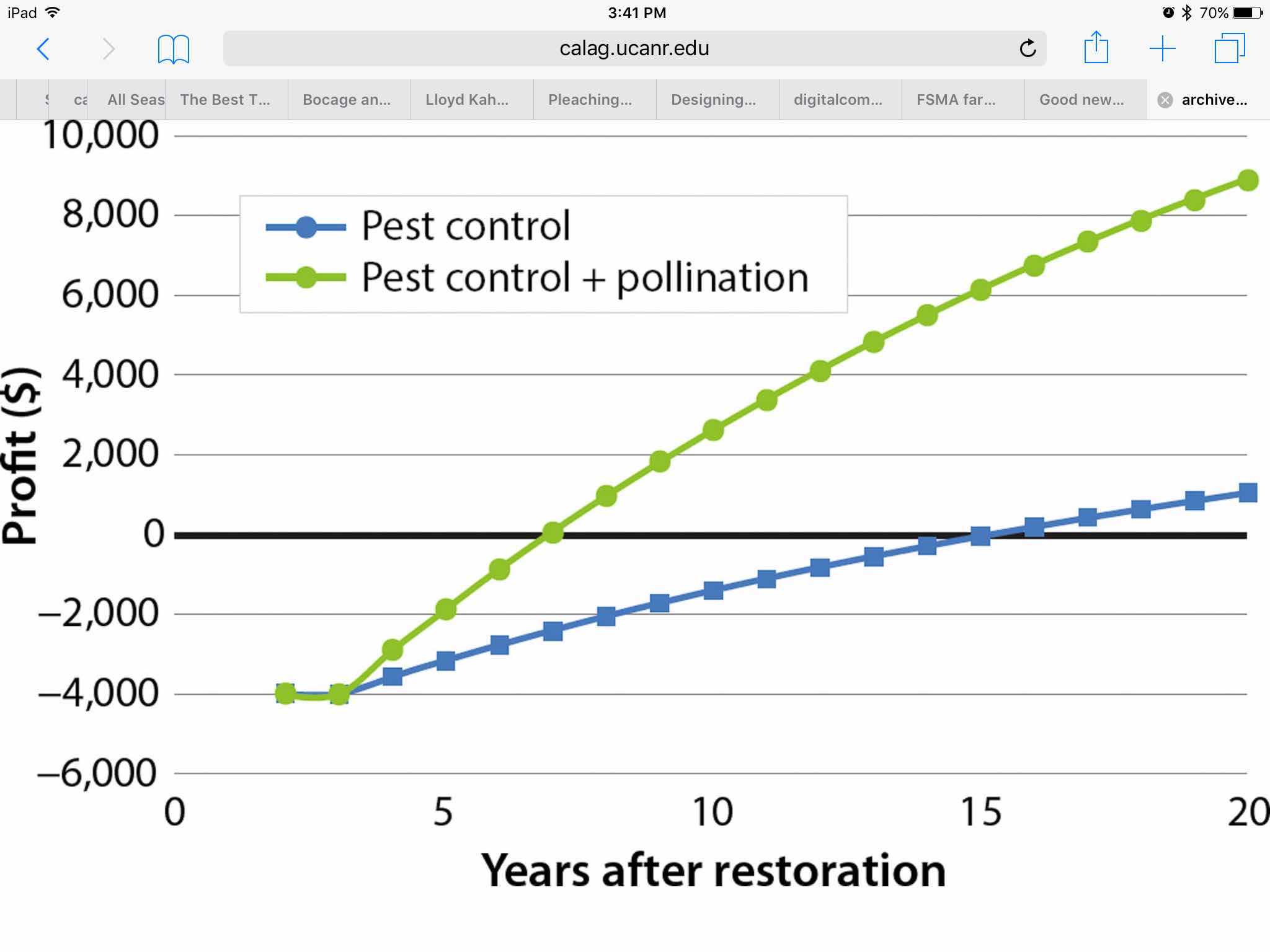
But many studies have show that the improvements to ecosystem health from restoring hedgerows do carry benefits to humans in farming, gardening, home or other productive landscapes, including reduction in pests, and increase in pollination. 


In addition to a positive effect ecosystems, hedgerows can have more direct benefits and yields to humans depending upon their design, including firewood, building materials, reduced irrigation, increase soil fertility, free fertilizer, improved soil carbon, reduced soil loss, garden stakes and trellises, tool handles, better plant growth from shelter, and of course, foods and medicines. In most places where hedgerows exist, they have long been seen as an important source of both. 

Designing an Edible Hedgerow or Tapestry Hedge

While one can use similar techniques for broad-scale windbreaks or livestock enclosures by making appropriate adaptations, this article will focuss on the small-scale edible hedgerow or tapestry hedge, based off of European designs and traditions. 

It was a couple of our favorite foraging spots which inspired our desire to have an edible fence. One in particular, was a naturally-occuring hedgerow that produced a large variety and quantity of fruits, nuts and vegetables throughout the season, all with little to no annual maintenance from humans. 

Compared to our hard work as guest farm laborers, the high rewards and low maintenance of our favorite hedgerow seemed like a great idea, and we decided to "take it home" with us. 

But when we began looking into expert recommendations on how to grow an edible hedge in the US, we were surprised to see everyone advocating against the species and spacings that was common to our favorite foraging spots. 

Was mother nature growing these natural food forests all wrong, as the experts suggested? 

Traditional Spacings: Tight!

However, when we looked into resources on traditional hedge culture, species and techniques in other countries, we found systems that looked very much like what was occuring naturally at our favorite high-productivity, low-maintenance spots. (Mueller, European Field Boundaries Volumes 1 &2, etc.)

While modern US recommendations look very different in terms of species selection, and management, the biggest difference between traditional hedge, hedgerow and windbreak technologies, and modern recommendations (at least in the US) is in spacings. Most common recommendations I can find from US sources recommend planting at spacings where crowns just intermix or touch at maturity (perhaps 7-10' centers for many shrub species, with many suggesting 5' was too tight) whereas traditional forms typically space plants at 1- 2 1/2'. 

While these seem very close to a gardener, these spacings approximate what one commonly sees occuring in natural thickets in many biomes, including our favorite foraging locations. 

But, despite the expert recommendations, these tight naturalistic plantings found in traditional hedgery, which have proven their effectiveness in experiments over millennia, have become the cutting edge of scientific forestry (as well as many Permaculture circles) throughout the world, since the 1980s when a Japanese forester named Akira Miyawaki took notice of the way Nature grows forests.

It's no coincidence that this evolved technology of hedgerows closely resembles the cutting edge reforestation program referred to as the Miyawaki technique. Miyawaki was a forester interested in regrowing healthy forests in Japan for purpose of maintaining habitat, controlling erosion, sequestering carbon and solving other problems through the ecosystem services, who noticed that the plant spacings and communities used in "conventional" forestry practice looked nothing at all like the types of spacings and communities that would occur during natural reforestation, and that the conventional approach often performed poorly in comparison to the way nature solved this same problem. He hypothesized that the conventional recommendations were tested and developed to optimize commercial yield in various ways, not to optimize fast, easy cost-effective establishment of healthy forest. Basing his approach off of the observation of naturally-occuring rapid reforestation, he developed a system of using seed from locally-adapted, free specimens, with intermixed stages of succession, at very tight plantings, and he found that nature was solving the problem the right way. Across many climates and ecosystem types, Miyawaki's technique has been replicated and found to far out-perform conventional practice, with far less cost and fewer destructive chemical inputs. 

Indeed, some US sources appear to criticize Miyawaki's methods as inappropriate to North America's idealized "natural landscapes," because they do not leave enough room for our most important North American "nature area" keystone species: tax dollars, corporate petrochemicals, herbicides, and heavy machinery. 

For some, it's counter-intuitive, but research has found that even on spare soils in dry climates with a risk of desertification, the tight plantings of the Miyawaki technique lead to rapid establishment with little after-planting care, even where conventional techniques failed with continued Intervention!

This goes well with current ecological theory and research, which has found that while we previously believed that competition between plants would impair growth and establishment, in such tight, naturalistic plantings cooperation out-weighs competition and gives the individuals an advantage compared to situations with unnaturally wide plant spacings. 


(Integrated Hedgerow design by Bill Mollison, for Semi-tropical climate)

Moreover, with rapid, dense growth, we humans can begin to reap the rewards of ecosystem services - windbreak, enhanced microclimates, erosion-prevention, water harvest, buffering, wildlife habitat, biodiversity and food (under tight plantings most species will bare "precociously" at an early age) - in a very short order, rather than struggling with establishment for 15 years for a wind-break to finally serve its purpose. With all this, it's no wonder that cutting-edge Permaculture designers like Geoff Lawton have begun to implement Miyawki's research for such applications as forest gardens, ally cropping and, of course, hedgerows. 

As a very rough guideline, my recommendation for a hedge where production is the main goal is to plant into a 10' wide strip of at least 30' of length (to have much room for diversity) with larger woody perennials at 2'-3', and with smaller woody shrubs and herbaceous perennials filling in the gaps to create approximately 1' spacings. I typically don't plant anything direcly between woody perennials, except perhaps for short-term crops like Jerusalem artichokes, which can provide a big yield in early years, ensure a complete hedge effect in the first season, provide ample biomass for mulch, and then die back as woody perennials establish. For best results, very plants by height, and species, planting main species such as hazelnuts at standard spacings, and filling in the gaps with smaller species. For larger hedgerows and windbreaks, I recommend multiple rows of woody perennials, but still at tight plantings. For hedges where security or animal enclosure is the main goal, I recommend 1' spacings, with a high percentage of thorny species such as hawthorn, blackthorn, or sea buckthorn. 


Permaculture Design Parameters:

With hedgerows being so useful, it's no wonder that many of Mollison's early designs included hedges, shelterbelts, sun-traps and windbreaks. Permaculture 2 is filled with whole sections on these features. 

In addition to siting the hedgerow to provide as many benefits as possible, one should consider mechanisms to insure adequate water and appropriate drainage. Hedgerows are excellent features on swales or micro-swales. Net and pan design can be used to make watering easy and help plantings be self-watering. We used a system of net and pan along with trench composing swales to make sure that water would flow down our hedgerow, providing adequate water to our young trees during establishment while also keeping water from completely filling planting holes on our very compacted soils with extremely poor drainage. This can be seen in some of the establishment shots in our Hedgerow video. Integration with keyhole gardens and "edible border gardens" are an excellent idea, and common in the English and French gardening traditions. 

Species selection for Temperate regions

For our main woody perennials, we'll need plants that share a few major charactaristics:
1. They can thrive in tight, wild plantings.
2. They are disease and pest resistant.
3. They take well to coppicing, or hard pruning techniques where they are periodically cut back to the ground. 


Traditional hedge management simplifies pruning and maintains health and productivity.

Major species will make up 50-60% of the multi-purpose edible hedge, and include hazelnut, hawthorn, blackthorn or bullaces, sea buckthorn or autumn olive if it is not invasive in your region. Note that European wild plums take to coppicing well, but according to USDA research American species of wild plums do not. Also note that there are some American species of hawthorns that take well to coppicing and are high quality edible fruits, which far surpass the European species. To maximize productivity, these major species should be spaced at essentially orchard spacings, approx 12-15' depending. 

Support species should fill in the gaps between, still alternating heights when possible. My recommendations for these include: Asian pears, wild pears, rugosa roses, goumi, elderberry, medlar, currants, and brambles. Note that I do not include apples, European pears, or other common culinary fruits, as they are unlikely to be healthy and productive in such conditions. Occasionally I encounter an instance which excepts this rule, but in most cases, I would not expect them to do well in an edible hedge, and are more appropriate to other growing systems.  

Finally, a great deal of additional plants can add to the productivity and biodiversity of the edible hedge, including: 


For more information, ideas, and resources on hedgerow culture, visit our previous article on hedgerows                                        

Resources
NOTE: in the following list, care should be taken to ensure that species are not invasive to your region, are appropriate to your specific sites and soils, and appropriate to "coppicing." 
1. Suitable species for Australia, from a Permculture perspective: https://permaculture.com.au/venerating-and-regenerating-hedgerows/
3. Hedgerow medicines: http://www.hedgerowmedicine.com/
4. Hedgerow foraging in UK, applicable to mant temperate climates, http://www.wildfooduk.com/hedgerow-food-guide/

Selected Citations (more research sources appear in text above)
1. Countour Hedgerows increase soil and water health in the tropics: https://www.sciencedirect.com/science/article/pii/0167880995010122
2. Incease wildlife and biodiversity, UK: http://www.hedgelink.org.uk/index.php?page=21
2. Hedgerows reduce risk of food contamination: http://ucanr.edu/blogs/blogcore/postdetail.cfm?postnum=26370
3. Hedges reduce pests and increase pollination.http://calag.ucanr.edu/archive/?article=ca.2017a0020
reduction in pests, and increase in pollination.  1- 2 1/2'. 1- 2 1/2'. 

Monday, April 27, 2015

A Forest Garden for Every Occasion


While "Food Forests" or "Forest Gardens" have become something of a gardening fad these days, there's really nothing new about them at all. In fact, some academic sources have begun calling them "the world's oldest land use."  

In my opinion, we modern "Forest Gardeners" have a lot to learn from the traditional, slowly-evolved gardens that were once the backbone of cultures around the world. Researchers across many disciplines from Agronomy and economics to ecology and anthropology have delved deeply into the well-known, ancient food forests across the Asian and African tropics (as well as the Amazon, which some researchers have begun to charactarize as the world's largest food forest!) with some of the most famous being the "Home Gardens" of Kerala, India, that inspired the modern Food Forest trend. And as we come to understand how those systems function, both socially and ecologically, we're recognizing their universality, seeing well-developed and culturally appropriate Forest Garden systems in the pre-columbian Americas, and even in the temperate and cold regions of North Asia, Northern Scandinavia, Russia, the "black forest" of Germany, the Mediterranean, and the British Islands. 

Looking at all these long-lasting, highly successful systems, it's amazing how much they have in common, and to me, that implies that there are a few patterns for us to learn from and emulate if we want our Forest Gardens to have similar staying power. 

One of these universal patterns is a recognition of proximity: people have different sorts of forest gardens depending on how far they are from home. Permaculture Designers honor this traditional wisdom with the concept of different "zones" the further away you are from home. 

Based on this wisdom, many of these traditional forest gardening cultures developed two different systems, one for home and a second system for the public commons further from home.

There are now some nice studies of how these distinct home and public garden systems work in traditional cultures, such as this one: 


In these systems, home Forest Gardens provide families with luxurious high-value fruits and vegetables, a wide variety of spices and herbs, the majority of their food and some excess for trade and income, and of course, beautiful living space. These crops require daily care and attention to thrive but are well worth the effort, if placed close to the home where that attention happens naturally without special effort.


Meanwhile, the public systems rely heavily on nature and succession to do the work, since they're far from  home and travel amplifies the "costs" of human labor and energy inputs. These systems are typically harvested collectively for commuity income, fibre, building materials, low-maintenance calorie crops, and a variety of low-maintenance fruit, vegetables, and spices for the market that can be grown extensively working with sucession. 

Many of these lots are visited just once a year--or less--because harvest and nature provides almost all the management. These are the famous "swidden" systems of the old world that start with clearing old food forest for lumber, planting new trees along with a ground cover of anual crops, and provide a cascade of different crops as the forest matures, until it's time to clear it again in 15 or 20 years. 


(Photo: http://press.anu.edu.au/apps/bookworm/view/Transcending+the+Culture–Nature+Divide+in+Cultural+Heritage/10901/ch14-oconnor.xhtml)

Beyond the tropics, the traditional temperate garden systems of Europe also evolved public and private versions that might make appropraite models for us in the Great Lakes Region. Up until the "green revolution" driven by fossil fuels, Medieval Great Britain, for example, evolved a complex system where the famous "cottage garden" was the centerpiece of home health and nutrition, as a home Forest Garden of high value fruit trees that require pampering, mingle with perennial and anual vegetables, flowers, and medicines growing together in an ecological assemblage that today would look "wild" to the modern gardener. 

Next, there were community "allotments" inside the settlement and close to the living quarters, where low-labor cultivated fruit trees and perennials and self-sown vegetables kept maintenance low. 

Beyond that in an outer zone from the community was the cultivated farmland where grains were grown communally, integrated with a Forest Garden system of Multi-purpose "hedgerows" of wild (or semi-wild) fruit, medicinal plants, building materials, fuel, vegetables, mushrooms and wild game. 

Wood for fuel, construction and crafts was grown in managed Forest Garden systems called copses, where shade-loving vegetables and medicines, chestnuts and hazelnuts, a wide variety of mushrooms and game were also harvested. This system of common hedgerows and coppice lots was also freely used by families and farmers to graze and fatten their livestock. This system changed and evolved along with the culture, but remained in some vestigal form right up until oil came to dominate our lives. 


A very similar system evolved in France, with its famous hedgerows, communal woodlands, and semi-managed (by grazing) common hillsides where villagers would collect medicinal and culinary herbs, such as the famous "Herb du Provence." 

Meanwhile, the "Jardin de Cure," or Parishiner's Garden, may have been the original multi-purpose, ecological "Permaculture Community Garden" and "Edible Landscaping!" 

These gardens, usually centrally located at the village church, were created by village volunteers for their busy Curate, the leader of their church. They had to be multi-functional, beautiful, and work with nature to be low-maintenance. They needed to provide the Curate and his Parish a beautiful spiritual place for contemplation and comfort in times of crisis. And they also had to grow high quailty fruits and vegetables for the Curate as well as special church celebrations, cut flowers for weddings, funerals and holidays, and also medicinal herbs--as the Curate, often the most learned man in the village, would also function as a healer. And the system of formal beds with semi-wild informal polyculture plantings allowed village volunteers to take care of it in their spare time. 

Up to now, most modern public and community Forest Gardens in the US have been designed to be demonstrations  of what could be done at home. I've visited a few that even included demonstration "zone 1" garden areas, modeling what should be done right outside of someone's front door, even though the nearest front door was at least a mile away. 

These are great gardens that filled a necessary educational role, and provided design opportunities for new designers. But now that home forest gardens (actually at people's homes!) are becoming common across America, I would encourage the next generation of projects to aim to reflect the traditional common sense of proximity, and to research and demonstrate the value that Forest Gardens can bring to the real public commons. 

To think about it in Permaculture terms, almost all public and community Forest Gardens are going to be in zone 4! So, rather than demonstrate "zone 1 and 2" on those sites, we should figure out how to demonstrate the concept of zones by designing great zone 4 gardens that really make sense!

Examining these traditional home and public systems, here are some patterns we can begin to learn from:

Home Forest Gardens:
--Extremely high diversity--people like to collect plants!
--More intensive: high-input items like cultivated fruits, fruits that REQUIRE harvest, more anual vegetables, salad crops, etc. This is where you'll find difficult fruits like dessert apples and plums.
--Emphasis on low-processing, high nutrition food crops to be used fresh. 
--Multi-purose landscape that integrates food production into PRIVATE yard functions such as home parties, contemplation, outdoor cooking, relaxation...
--Uses human labor to plant and maintain select plant specimens such as grafted trees. 
--Provide families with fresh fruit and vegetables, medicines, a beautiful home environment, excess production can be "scaled up" for income, recreation (gardening)


Public Agriforest Systems:
--Lower diversity, only aggressive plants that will fend for themselves if neglected.
--Plants appropriate for the stage of succession, ie. pioneer species in young gardens. 
--Very extensive, plants that rely on nature and succession to tend them, such as wild edibles, "weeds," berries, wild fruits, etc. 
--Emphasis on low-maintenance: high-calorie food crops like corn, squash and grains, durable foods like spices, animal fodder (animals don't typically require pampered and perfect fruits and vegetables,) and non-food crops like building and crafting materials. 
--Multi-purpose landscape that integrates food production into PUBLIC functions such as farming, hunting, travel (road-sides) community meeting space, religious worship, etc. 
--Largely relies on natural systems and succession. For a temperate example, look at the "dead hedging" and "tapestry hedge" systems of Britain and France, where a rudimentary fence was made of wood and stone, understanding that birds would perch there and other animals would then inhabit the "hedge," and their droppings would plant high-value edible plants. Meanwhile, these systems were guided by throwing down seeds and selecting for the most desirable species as the "hedge" filled in. 
--Provides a community with the VALUE of fuel, building materials, jobs, foraged "wild" fruits and vegetables, wildlife habitat--and MOST IMPORTANTLY, they do this without creating a burden for the community that has to be maintained with "volunteer" labor, fossil fuels and ongoing inputs. 

To me, the most important thing we can learn from these dual traditional systems is that if we're asking "who will maintain it and how will it be maintained?" then we're asking the wrong question. Either, it's private and that answer is obvious, or it's public, and it would traditionally be designed so that use, harvest and natural succession provide most of the maintenance required. 

All of America's new public and community Forest Gardens represent an inspiring view of what we can accomplish when we work together. And it's even more inspiring for me to think of what the future could bring, as these systems evolve to better serve the American landscape and bring value to American communities. More importantly, as a Permaculturist and community member, I look forward to public projects that compliment the forest garden I have at home in the way they do in traditional cultures. 


Monday, March 2, 2015

Designing a Permaculture Hedgerow


Last night, I had the opportunity to join in a permaculture discussion where hedgerows came up, and people who know me know that I'm crazy about hedges. As modern agricultural research turns towards perennial crops, and polyculture plantings, the hedgerow stands out as a traditional and uniquely adapted system for utilizing both. Better still, these woody perennial polyculture systems can do extra work by providing building and craft materials, ample carbonaceous material for composting, providing windbreaks, wildlife shelter, fences for wildlife, create fire and erosion barriers, provide forage, protect livestock or humans, and greatly increase the biodiversity that has a positive benefit on pest and disease problems and system health and resilience. 


Far more than mere shrubbery, hedgerows represent the original "food forest" technology of cold temperate climates, with their linear nature being a perfect adaptation of forest gardening to northern latitudes where light penetration becomes key. And since forest gardening has been called "the world's oldest land use" by anthropologists, it's no wonder that where you find hedgerows they're fundamental to cuisine, medicine, magic, shelter... and life in general.

If the hedge-bug bites you, you can delve deeply into our cultural heritage with a Google quest across the the rich topic of the Hedge, by exploring:
Hedgemedicine
Hedge-laying 
Hedge-witchery/Hedge-wizardry
Hedgerow foraging
Tapestry Hedges
French Hedgerows in WWII
The Hortus Conclusus

--------------------- 

At Lillie House, our research into hedge-tech has focused on adapting the traditional systems of British and French hedgerows, especially the English "cut and lay hedge" and the French "woven hedge" to the Great Lakes region by using bio-mimicry of the spontaneous, natural hedge-like systems that arise throughout the region. Some of our favorite foraging areas have been these natural hedgerows and we've aimed to study and recreate them at our home.


A generalized European planting would typically use:
A "thorny" main structural planting of 60% Hawthorn or Blackthorn (wild plum) or 30% of each of those. In addition to thorns, these species spread by sucker to fill in dead sections, and take very well to "coppicing," and creating tight woven hedges. 
10-20% Hazel. Hazel was sometimes used as the "main planting," especially in more urban areas where nuts were desirable and 
And a mix of: roses, brambles, elder, crab-apples, damsons, sloes, and wild apples and pears.
Hedgerows intended as wind breaks might include 10-30% evergreens, including yew. Science has verified the wisdom of this traditional approach, finding that a greater density of evergreens increases the turbulance of winter winds, actually increasing the problem instead of reducing it.

To get an idea of these plantings, try looking at some of the offerings of the many British companies selling traditional Hedgerow plants:


For the Great Lakes region, many of these plants could be adapted at least in function, though Blackthorn may experience problems with black rot. Good substitutes for the primary planting could include Sea Buckthorn or Goumi, which both fix nitrogen and coppice well. 

Our US wild plums do not generally coppice well, so they aren't good choices, however other prunus species like Nanking Cherry make good substitutes. 


Rugosa roses make an excellent choice for the US, as do our native elders. Blackberries  or wild black raspberries would also be quite at home in such a planting. Mulberries are commonly found in natural hedgerows here, and I suspect that after some extra work to get it established, Paw Paw would be very happy with life in a hedgerow, too, as it suckers, tolerates shade and takes to coppicing well.  

Through your next drive through the country, a quick look out the window and you're likely to see exactly this kind of plant community growing wild in the ditches. One even happens to be growing along the bike trail down the street for us, which is the one we copied for our planting. There are probably several near your home that could serve as the basis for your hedgerow. 


But not all trees will work well. French and British models typically excluded trees that would be allelopathic (toxic to other plants) or those that quickly sucker and are very tolerant of shade, as they become weedy in a hedgerow. Norway maple, willows, certain dogwoods, and even English elder (a stereotypical Hedgerow tree) were often avoided, depending on the site. Tall trees such as oak, linden and maple were often included, but spaced at least 2 or 3 times mature orcahrd spacing, perhaps 200' apart. These rules typically aimed to keep hedge maintenance low by reducing pruning and weeding. 

Once you have your trees chosen, you'll have a wide variety of perennial vegetables and fruits that are ideally suited to the conditions of a hedgerow. At LillieHouse, these include: strawberries, sea kale, asparagus, good king henry, sorrel, endive (chicory) nettles, poke, comfrey, stinky bob, perennial alliums (we have over a dozen varieties) cleavers, milkweed, turkish rocket, sweet rocket, jerusalem artichokes, japanese yam, grapes, kiwi, ground nut, ground pea, ladies thumb, clover, salad burnet, spring beauty, mints, and many others! Hedgerows naturally take advantage of "edge effect" making them an ideal place for a huge variety of species. 


------------------

Once you have an idea about what plants you want in your hedgerow, you'll need to make a plan for establishing it. Like all things in appropriate technology, traditional technology and Permaculture, the trick here is finding the right balance of "intensive" and "extensive" tools for the job. Traditional European hedge systems provide us with a wide range of options here, from the careful and deliberate plantings of urban French Tapestry Hedges to the nature-assisted systems of "dead hedging." 


Any one hedge is likely to use a mix of hedging approaches, but arranging them in order of intensive to extensive, they might look like this:
1. Intensively planted urban or "zone 1 or 2" hedges close to the home: Hand planted at high density around 1-2' apart, relying on selected short tree species chosen to give a yield of fruit, nuts, berries beautiful folliage and flowers. Shorter species make the hedgerow less labor to maintain.  
2. Semi-intensive: hand-plants pioneer species like elder, prunus species, and hazel at a greater distance of 3-5' or more. Birds, mamals, and suckering fill in the hedge. Oftentimes, hedge-layers would encourage the process by throwing fruit cores and seeds into the hedgerow. 
3. Sacrificial planting: very fast growing trees are planted at a useful density 2-3' and quickly woven into a hedge. Later, these trees are selected out as more desirable species fill in. Trees especially suited to this might include empress tree, toon tree, and hybrid poplar.
4. Dead hedging: using available materials, pruinings and fallen wood to build a temporary fence to meet your needs. Over time, perching birds, and mammals help fill in the planting, reliably creating a hedgerow of useful mast and fruit species. The hedge-layer can help the process by occasionally planting in a few desirable species and selecting for the best plants. 


One of my favorite gardening blogs has a great post on how this mix of procedures is covered in the French literature here: 


---------------------

And finally, if you've come this far into hedge-geekery, thanks for your time! You can find even more info on our hedgerows by searching this blog, if you like. Better yet, take a minute to look at some pictures of these traditional French and British systems:

1. Google search for British "hedge laying."

2. French tapestry hedges:

And finally, if you're planning a hedgerow, please drop me a comment and let me know about it. As a certifiable hedge-geek, I'd love to hear about your project. 

----------------

Edited to add a section of recommended hedge-related resources:

http://www.thesurvivalpodcast.com/plants-for-food-hedges-fedges a piece on food hedges, with a good understanding of traditional hedge systems. 

Monday, November 24, 2014

Designing a Permaculture Hedgerow


Last night, I had the opportunity to join in a permaculture discussion where hedgerows came up, and people who know me know that I'm crazy about hedges. As modern agricultural research turns towards perennial crops, and polyculture plantings, the hedgerow stands out as a traditional and uniquely adapted system for utilizing both. Better still, these woody perennial polyculture systems can do extra work by providing building and craft materials, ample carbonaceous material for composting, providing windbreaks, wildlife shelter, fences for wildlife, create fire and erosion barriers, provide forage, protect livestock or humans, and greatly increase the biodiversity that has a positive benefit on pest and disease problems and system health and resilience. 

Far more than mere shrubbery, hedgerows represent the original "food forest" technology of cold temperate climates, with their linear nature being a perfect adaptation of forest gardening to northern latitudes where light penetration becomes key. And since forest gardening has been called "the world's oldest land use" by anthropologists, it's no wonder that where you find hedgerows they're fundamental to cuisine, medicine, magic, shelter... and life in general.

If the hedge-bug bites you, you can delve deeply into our cultural heritage with a Google quest across the the rich topic of the Hedge, by exploring:
Hedgemedicine
Hedge-laying 
Hedge-witchery/Hedge-wizardry
Hedgerow foraging
Tapestry Hedges
French Hedgerows in WWII
The Hortus Conclusus

--------------------- 

At Lillie House, our research into hedge-tech has focused on adapting the traditional systems of British and French hedgerows, especially the English "cut and lay hedge" and the French "woven hedge" to the Great Lakes region by using bio-mimicry of the spontaneous, natural hedge-like systems that arise throughout the region. Some of our favorite foraging areas have been these natural hedgerows and we've aimed to study and recreate them at our home.


A generalized European planting would typically use:
A "thorny" main structural planting of 60% Hawthorn or Blackthorn (wild plum) or 30% of each of those. In addition to thorns, these species spread by sucker to fill in dead sections, and take very well to "coppicing," and creating tight woven hedges. 
10-20% Hazel. Hazel was sometimes used as the "main planting," especially in more urban areas where nuts were desirable and 
And a mix of: roses, brambles, elder, crab-apples, damsons, sloes, and wild apples and pears.
Hedgerows intended as wind breaks might include 10-30% evergreens, including yew. Science has verified the wisdom of this traditional approach, finding that a greater density of evergreens increases the turbulance of winter winds, actually increasing the problem instead of reducing it.

To get an idea of these plantings, try looking at some of the offerings of the many British companies selling traditional Hedgerow plants:


For the Great Lakes region, many of these plants could be adapted at least in function, though Blackthorn may experience problems with black rot. Good substitutes for the primary planting could include Sea Buckthorn or Goumi, which both fix nitrogen and coppice well. 

Our US wild plums do not generally coppice well, so they aren't good choices, however other prunus species like Nanking Cherry make good substitutes. 


Rugosa roses make an excellent choice for the US, as do our native elders. Blackberries  or wild black raspberries would also be quite at home in such a planting. Mulberries are commonly found in natural hedgerows here, and I suspect that after some extra work to get it established, Paw Paw would be very happy with life in a hedgerow, too, as it suckers, tolerates shade and takes to coppicig well.  

Through your next drive through the country, a quick look out the window and you're likely to see exactly this kind of plant community growing wild in the ditches. One even happens to be growing along the bike trail down the street for us, which is the one we copied for our planting. There are probably several near your home that could serve as the basis for your hedgerow. 

But not all trees will work well. French and British models typically excluded trees that would be allelopathic (toxic to other plants) or those that quickly sucker and are very tolerant of shade, as they become weedy in a hedgerow. Norway maple, willows, certain dogwoods, and even English elder (a stereotypical Hedgerow tree) were often avoided, depending on the site. Tall trees such as oak, linden and maple were often included, but spaced at least 2 or 3 times mature orcahrd spacing, perhaps 200' apart. These rules typically aimed to keep hedge maintenance low by reducing pruning and weeding. 

Once you have your trees chosen, you'll have a wide variety of perennial vegetables and fruits that are ideally suited to the conditions of a hedgerow. At LillieHouse, these include: strawberries, sea kale, asparagus, good king henry, sorrel, endive (chicory) nettles, poke, comfrey, stinky bob, perennial alliums (we have over a dozen varieties) cleavers, milkweed, turkish rocket, sweet rocket, jerusalem artichokes, japanese yam, grapes, kiwi, ground nut, ground pea, ladies thumb, clover, salad burnet, spring beauty, mints, and many others! Hedgerows naturally take advantage of "edge effect" making them an ideal place for a huge variety of species. 

------------------

Once you have an idea about what plants you want in your hedgerow, you'll need to make a plan for establishing it. Like all things in appropriate technology, traditional technology and Permaculture, the trick here is finding the right balance of "intensive" and "extensive" tools for the job. Traditional European hedge systems provide us with a wide range of options here, from the careful and deliberate plantings of urban French Tapestry Hedges to the nature-assisted systems of "dead hedging." 


Any one hedge is likely to use a mix of hedging approaches, but arranging them in order of intensive to extensive, they might look like this:
1. Intensively planted urban or "zone 1 or 2" hedges close to the home: Hand planted at high density around 1-2' apart, relying on selected short tree species chosen to give a yield of fruit, nuts, berries beautiful folliage and flowers. Shorter species make the hedgerow less labor to maintain.  
2. Semi-intensive: hand-plants pioneer species like elder, prunus species, and hazel at a greater distance of 3-5' or more. Birds, mamals, and suckering fill in the hedge. Oftentimes, hedge-layers would encourage the process by throwing fruit cores and seeds into the hedgerow. 
3. Sacrificial planting: very fast growing trees are planted at a useful density 2-3' and quickly woven into a hedge. Later, these trees are selected out as more desirable species fill in. Trees especially suited to this might include empress tree, toon tree, and hybrid poplar.
4. Dead hedging: using available materials, pruinings and fallen wood to build a temporary fence to meet your needs. Over time, perching birds, and mammals help fill in the planting, reliably creating a hedgerow of useful mast and fruit species. The hedge-layer can help the process by occasionally planting in a few desirable species and selecting for the best plants. 

One of my favorite gardening blogs has a great post on how this mix of procedures is covered in the French literature here: 


---------------------

And finally, if you've come this far into hedge-geekery, thanks for your time! You can find even more info on our hedgerows by searching this blog, if you like. Better yet, take a minute to look at some pictures of these traditional French and British systems:

1. Google search for British "hedge laying."

2. French tapestry hedges:

And finally, if you're planning a hedgerow, please drop me a comment and let me know about it. As a certifiable hedge-geek, I'd love to hear about your project.