(Our beauty rat. She is our friend and garden collaborator, not a meat animal.)
Nope. I have no interest in entering the grand debate over veganism. Not going to do it. As per usual, I have no interest in taking sides. Most of the time, the opposite of a wrong idea is NOT a right one, but another wrong idea. In this case, I believe there is a time for being vegan, and a time for not. It is another great tool, which can either be used for good, or misused. So what I am interested in is some discussion about this tool, and how we can use it.
Some people so strongly associate Permaculture with animals that I often hear people wonder: Can Permaculture be vegan?
Does being vegan preclude being a Permaculturist? Or vice versa?
No! Absolutely not! There are many examples of people doing veganic Permaculture. In fact, most people who have a Permaculture design for their yards, businesses, farms, etc. don't have farm animals. And for those interested in Pursuing a strictly veganic form of Permaculture, I recommend the Vegan Book of Permaculture.

(Our other critter. Such lazy critters.)
However, the topic is a hot one and worth writing about with a little more depth. There are two common debates at the intersection of veganic Permaculture: Do animals belong on the table? And do animals belong on the farm?
First, the table.
After deep reading, years of dietary experimentation including being vegan off and on, and research into the sustainability of veganism, here's my position:
Being vegan is a good, simple tool anyone on a standard American diet can use to have a MORE humane, sustainable (and probably) healthier lifestyle.
Let's be clear: After reading literally dozens of critiques of the sustainability of veganism, I haven't seen a single article EVER that disagrees with this point. Every critique of veganism I've seen compares it to an ideal non-vegan food system that COULD exist, somewhere. The only critique I've ever seen is that veganism is not perfect. It could be more sustainable. It could be healthier (for some people at some times.) If you get your meat from an idealized regenerative farmer doing perfect best practices in a humane way, it could be both those things and fight climate change at the same time. But what remains is that for most people living in the actual world, who don't want to do years of experimentation and in-depth research comparing avocados to butter, and who don't know the Perfect Farmer, veganism is a totally legit choice. Anyone arguing otherwise is probably just being defensive because they love bacon.
So, are we vegan? Nope.
I have been vegan for lengthy periods of time, and I still aspire to be vegan, but ultimately I have other priorities that outweigh being vegan. Being vegan is not perfect. At least not for me.
One of those priorities is our particular health goals and situation. For years I believed the common saying that I could get enough protein from plants without worrying about it. And that the modern diet has too much protein. I never questioned this and I never looked into the science. It sounded truthy.
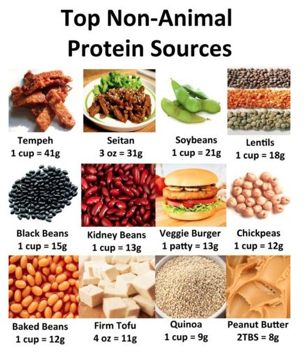
(Meme spread far and wide on FB. I double-checked most of these numbers on Google.)
For me, the recommended minimum daily intake of protein is 64 grams on a relatively sedentary day.* That's about what's in a single chicken breast. Half a chicken breast added to one meal guarantees I hit that minimum, and stay at a reasonable carbohydrate and calorie count. Unfortunately, I avoid eating chicken. Using vegan sources, hitting this minimum target is more complicated. Lentils are often listed as the single best unprocessed vegan protein source. One large bowl of vegan lentil soup will have 20g protein, and is very filling. I can eat nothing but lentil soup all day long and still not hit my protein minimum. Meanwhile, I've had over 200g of carbohydrates. If I decide to eat anything but lentils, it gets harder to hit my minimum, while the carb rate sky-rockets. For example, I have to eat about 5 cups of black beans, 6 cups of baked beans, or 7 cups of quinoa per day!
I feel stuffed just thinking about it.
But the truth is, most people with a sedentary American lifestyle probably don't need that much protein, most of the time. With some effort, you can probably get close enough to avoid negative health impacts.
But as soon as I become very active on the homestead, or go into a calorie deficit, researchers say my protein intake should go above 100-120g of protein/day (or higher) to avoid negative health consequences, aging, metabolic decline, increase in cortisol (stress hormone) and loss of muscle mass. Now I'm dependent on commercially processed food sources like tempeh or seitan products if I want to get anywhere near that on a vegan diet. Still, this would be very, very difficult.
Realistically, as a homesteader on a vegan diet, my protein intake was closer to 30g/day. Often less. Over the years, this had started to cause health problems, including the vexing issue of simultaneous weight loss (muscle loss) and fat gain. 2 years ago, I weighed 10 lbs LESS than I had in my entire adult life, yet my waist was 6 inches larger than it had ever been and I was getting out of breath going up the stairs! This is exactly the result that a large amount of research would predict given my level of activity and protein consumption. Which is why I have come to rely on eggs, dairy, and occasionally even meat to get closer to my minimum protein target. I still rarely hit that minimum. But the intentional increase in protein reversed the muscle loss and fat gain I was experiencing on my low-protein diet. 2 years later, I weigh 10lbs more and my waist is 6 inches smaller, and I can't deny that the mindful protein increase was a major part of this.
Those on a prescribed diet from a doctor or dietician for dealing with diabetes or obesity might have a goal of getting 160g protein with only 160g of carbohydrate. Unfortunately, I cannot find a way to make that work on a vegan diet, period. 8 bowls of the lentil soup (which makes a best-case high-protein vegan food) hits the protein, but also close to 400g of carbohydrate. See the difficulty?
So many vegans dismiss these goals instead of trying to meet them. I find it difficult to dismiss the research in every case. Rather than present the nutritional research myself, here's an article that includes a great deal of citation to the science available on protein in the diet.
https://completehumanperformance.com/2015/09/11/dieting-protein-needs/ * The recommendations at the end probably aren't necessary for most average people, even those looking to get into better shape. However, it's worth pointing out that even the lowest end of this spectrum becomes virtually impossible to achieve on a vegan diet - even for a single day - without supplementing with several protein shakes per day. (On a side note, our personal evaluation of protein supplements found dairy to be almost certainly more sustainable and less impactful to animals than any vegan source. It's also dramatically more affordable.) This isn't to say that it's impossible to be healthy and vegan. Simply that there are some reasonable nutritional goals that are difficult to meet as a vegan.
I'll simply conclude that being vegan might not always be a sustainable option for everyone to meet their health and diet goals all the time.
A second conflicting priority is ethics, both general sustainability and minimizing harm to human and non-human animals. For example, as a vegan I was using almond milk rather than dairy. However, the almond industry is a leading driver of cruelty to bees (both domesticated and wild,) cause of colony collapse, user of water and oil, and exploitive labor practices. It became hard for me to argue that even average organic dairy isn't more humane and sustainable option. Once I saw that, I stopped buying almond milk. I have similar concerns about soy, avocados, palm oil, coconut oil, bananas, jackfruit and most of the high-quality proteins listed above. While being vegan certainly remains a good option compared to the standard American diet, some of us may want to go "beyond vegan" in terms of ethical impact, which may mean limiting some of these foods that are essential to maintaining a healthy vegan diet. For me, this outweighs "purity." Of course, we also don't have to be "purists" about outcomes when being vegan is a good enough positive step for most. I won't judge any vegan for chosing almond milk as part of a complete vegan diet, but I am unwilling to do so myself.
A third conflicting priority is local economics. Many vegan staples are tropical. If I can sometimes substitute locally produced dairy and meat products which help strengthen our local economy, I sometimes make that choice.
And a fourth conflicting food priority is growing my own. In most years, we try to grow as large a portion of our diet as practically possible. Again, this is difficult if my diet is based on a large quantity of protein field crops, processed foods, and imported tropical goods. But with just dairy and eggs, I can turn garden produce into a complete healthy diet throughout the whole year, and make the most of what we grow. As a busy homesteader, I can have restaurant quality omlettes ready from garden to table in less than 10 minutes and ensure that the eggs came from a local, ethical source. And again, if a large portion of my calories are coming from home-grown corn, potatoes and sunchokes, (rather than lentils and tempeh) I have to work even harder to get into a healthy protein range.
Still, veganism remains a goal and ideal for us, and we still manage to eat vegan meals probably 50% of the time. And for many people, a vegan diet is a great tool to improve the ethics of their food choices without a great deal of thought and research.
Similarly, our garden COULD be 100% vegan, but it isn't.
(Or perhaps it is, depending on the perspective.) Veganic farming is another great, practical tool. Despite theoretical debates, there is simply no good, replicable research showing that domesticated animals are necessary to a healthy ecosystem or for farm fertility. Indeed, all the research I know of shows that net fertility is lost when you process plants through animals. Despite all the critiques in the Permaculture community, a cow is not a perpetual motion machine. A cow does not amplify the raw carbon or nitrogen from its feed, but subtracts from it, causing a net loss. I know of no reason why domesticated animals are necessary for farm fertility. I'm skeptical of the common argument from Permaculturists that cruelty is acceptable, because it is necessary. Ethicists tell us we should always be skeptical of claims that the end justifies the means.
Moreover, I'm skeptical of Permaculturists who frequently argue from a different perspective of "purity," as though the ideal hypothetically perfect Permaculture system justifies cruel or unsustainable practices.
I DO agree with the countless articles outlining the THEORETICAL reasons why meat farming might be more "natural," or sustainable, or regenerative than some othe hypothetical veganic system. And, I've personally seen same great farms I trust. But in practice, not all Permie farms are equal. I cannot eat meat from Joel Salatin's famously idealized PolyFace Farm, because what I see is unnecessarily cruel and inhumane treatment of animals in the name of "cleverness" or sustainability.
But again, the lines aren't clear and there are conflicting priorities. And some farms may be more sustainable and even more humane by NOT being strictly vegan.
We do not import manure, blood or bone meal, or other non-vegan products. However, we do engage in 3 questionably non-vegan practices: we compost (including vermicomosting,) we use rabbit manure from our (rescued) animal companions, and we encourage wildlife on our site by creating habitat.
To some, this does not preclude being vegan. But to others, it does and we're not interested in arguing for the sake of "purity."
It is not veganic to use animal manure in the compost pile or garden. But for us, dealing with our wastes in a regenerative, closed-loop way takes priority over being strictly "vegan." And some argue that vermicomposting is not vegan "if it is not a natural process," but that composting with worms IS vegan when it is "natural." For others, it's ok so long as it is humane. We try to be as humane as possible and minimize handling, but if someone else questions our purity, I feel no need to argue. The benefits of vermicomposting to the health of our ecosystem outweigh the need for purity.
And finally, in a healthy veganic Permaculture system, the interactions of domesticated animals need to be replaced by the interactions of wildlife. But the line of "domestication" gets complicated when one starts "keeping" wildlife on the land. For example, bee-keeping is generally regarded as non-vegan, though this is controversial and frequently debated. Likewise, some sources have problems with wildlife habitat that is not "natural." We cultivate wildlife, including native bee, bird, mammal and reptile habitat, and are keen to "exploit" them for their positive interactions. If someone wants to argue that's not vegan, then it's fine with us.
In the end, veganism isn't a badge of supperiority for us, it's a tool we use to get inspired and make better choices. And that's exactly what it can be for most people, whether we're talking about the diet, the wardrobe or the landscape. If you're going to knock it for not being perfect, then you better have a perfect system of your own, or at least a demonstrably better one. But at the same time, a purist approach might not always be the best for every situation. The key might be to just keep doing the best we can at moving in the right direction.