Tuesday, June 21, 2016

Forest Garden Life and May Harvest Totals


Life in a forest garden puts you in direct contact with sanity grounded in the earth, in the soil. The mysteries of life, death, and food become the backbone of everyday wisdom in a way that rewrites your whole understanding of life, nature, and our place in it.


While other gardeners, like farmers, are in a battle against nature to fend off "pests" and "weeds," in the struggle to get "our slice of the pie, the forest gardener works with nature, revving up the entire chain of life to grow the size of the pie! 


While the conventional farmer removes the ecosystem in order to convert ecosystems into people, the forest gardener creates beautiful, healthy, FUNCTIONAL ecosystems, and lives sustainably off the surplus produced by ecosystem function. It is an entirely different paradigm of production. 


This month I am most struck by this "revving up" of the whole system. The garden has come to life with birds, insects and other wildlife contributing their share to the ecosystem. And the soil itself has truly come to life! In the oldest parts of our garden, once-dead soil has become as rich, black, and beautiful as any natural forest soil I've seen!


"Beautiful." Yes, soil can be beautiful. I'm quite convinced that we humans have a built-in, ancient, hard-wired appreciation for soil that is rich and fertile, in the same way as we recognize the beauty of healthful produce. And we feel "just right"  in rich natural ecosystems that can provide for all our needs! How much more beautiful is a healthy, diverse ecosystem than a dying field of corn and dusty soil?


Unlike the warzone of conventional agriculture, the Permaculture garden is as beautiful as it is productive, a place that speaks to the soul: "here you are secure, here you are home!" 


May Report: 

The month of may brought many pleasures, including some of our favorite vegetables and flowers. But it also brought our biggest work load, with rampant growth to convert to productivity, lest it be let to convert into chaos, as unusable energy will necessarily do. The "hunger gap began to present itself, and although we had plenty of salad crops and vegetables, calorie crops became scarce, and will remain so to mid-June, when the season's first potatoes will appear. Figuring out a good source of plant-based carbohydrates for this season should be a priority project. 


Failure strikes!

This month, we also had a few minor setbacks. Our entire first planting of peas was eaten by wildlife, which was fairly predictable. In our first year, we had a very good crop of peas in that location, which is completely unprotected, but since then wildlife have taken an increasing toll. We had planned to move the peas to the front yard where they would be better protected, but simply didn't purcahse appropriate trellises. A small second succession is just beginning to produce in our front yard. 

For some reason, this year we had 0 germination with our pepper seed, which were from last year and possibly became over dry in storage. 

Aronia berries have been heavily pruned by both deer and rabbits, who seem to favor this plant over all others in our zone 3 "wild-life friendly" food forest. Meanwhile goumi, currants, gooseberries, elder, blackberries, black raspberries, and Romance cherries have had little to no browse damage. 


Work Summary:

May and June are the months of most increasing rampancy in our garden in Michigan. After the solstice, our garden tends to start naturally thinning with the hot and dry weather of summer. This means that May is typically the busiest month in the garden, with the exception of harvest season. 

Week 1: Work - 3 hours, weeding, grass, thistle.
Week 2: 13 hours mowing, nursery work, watering, mowing grass and doing "chop and drop." 
Week 3: 14 hours chop and drop, mowing, pruning, selecting canes for blackberries and raspberries, weedwacking and "edging" garden beds. 
Week 4: 2 hours, watering seedlings, planting. 
Total: 8 hours/week average


Harvests:

Overall, May was lower-yielding than other months, providing a huge amount and diversity of fresh vegetables for us, but little in the way of extra for sales. Best-case-scenario, our May yields likely provided $1,000 worth of potential value in plants, materials and food. At high market rates, perhaps as much as $1,500 worth of potential. 

(almost) daily asparagus for 3 weeks (Approximately 4 lbs)
4 boxes arugula
10 bundles scalions
1 dozen allium unifolium shoots (vegetable) 
6 boxes sorrel (priced as spinach)
24 bundles "rocketini" (priced as baby broccoli) 
12 packages salad mix
7 bundles mixed fresh herbs
7 heads butter lettuce
5 heads oak leaf lettuce
1 pint strawberries
1 package baby radishes
2 pints radish "rat tails" 
1 lbs winecap mushrooms
3 dozen green garlic
Equivilent 1 dozen fennel bulbs (actually 15+ small bulbs, 5 medium bulbs.)
Dried herbs for teas.

Minimum value: $350.

Harvested 72+ plants $400+ 

Mulch materials, compost, rabbit food, etc. 

Actual value of Total May yields: $850

Approximate hourly rate: $26.5/hour for garden work. 


As a final word, that is not a bad ROI. This is much better than the $3/hour many farmers bring home for their long hours. Again, the key to that profitability and to Permaculture, is lower work and input investment, letting ecosystems do the work for us. 


(Note: photos from late May-June.)


Friday, June 10, 2016

I'll Never Dig Compost into a Garden Again! The Worst Soil in Our Garden Has Had the Most Time, Effort and Compost!


Ugh. Just finished prepping and digging this teensy garden bed again this year, and I'll never do it again! In fact, I actually gave up about half way through and left it like that!

What a waste of time, energy and resources. A quick estimate "Return on Investment" analysis of the time I spend on this bed vs. the veggies we've gotten out of it, reveals that at best, we get a few dollars an hour worth of yield out of this bed.  

We decided to keep these two small "biointensive" garden beds in our Permaculture Zone 1 area both as test plots and to grow a few things that seemed harder to grow in our heavy mulch gardens with living ground covers. 

So, we double dug, burried tons of organic matter and dressed with a few inches of compost every year for 4 years, regularly watered and weeded, and treated with tons of time and love. And while the soil is much improved over where it started, it's still pretty pathetic! 


Freshly dug, it's hard as rocks, difficult to dig or weed, grey, dead-looking, dry and lifeless. I only found a few worms as I dug this bed. These dry clods reduce to fine dust when crushed between the fingers, with none of the  "crumby" soil texture that you'd find in a natural ecosystem. It would have take a lot of additional work to break that down into a fine "tillith" to plant seeds into. 

And this has had TONS of compost added to it, usually a few times a year! Far more than any other bed in our garden, probably by 10 times!

Of course, it still has a ways to go, since the Biointensive technique takes 10 years to create its ideal soil. 


Meanwhile, that picture above shows some Permaculture soil! That's a small perennial onion easily pulled from a nearby bed that's only half the age as the biointensive bed. Ha ha, we don't have to "dig" root veggies from our garden, because they almost always just pull right up! See that beautiful, crumby, moist, black soil? That's how easily weeds pull out of our Perma-soils, too. No weeder tool necessary. See that rich, black, moist, mulchy earth in the background? My gord, ain't that beautiful stuff? And it's had very little compost added, if any.


Here's a bit of heavily-mulched garden that was prepped at around the same time as the biointensive bed, with a bunch of waste organic matter from on site, and NO compost. Since then, the only care it's received is a quick "spot mulch" of organic matter, usually from nearby plants, and an occasional bit of grass clippings as a top dressing. But underneath, it's wonderous!


8 inches down, we're still in thick, rich, moist mulchy soil, filled with worms and mycelia. 3 worms just in that one picture, with probably over a dozen just in this little spot as I dug. And you can easily dig your arm down another 10 inches or more into light, rich, black, crumby soil. This soil has never been  dug. This soil has received NO compost or organic matter from off site. And yet it's light, moist, easy to work, and RIDDLED with life! 

And while "putting in the garden" in our biointensive bed requires hard work every year, weeding, digging, and carting around heavy compost, planting in our Permaculture beds simply requires harvesting some great perennial vegetables or plants, and plopping in a few new plugs in their place, right into the deep mulch. In this case, we pulled up a sorrel plant, harvested the leaves and potted up the plant to sell, then plunked in a purple broccoli in its place. 


Or for sowing seed in site, many seeds can just be sown right into the mulch surface! The squash bellow germinated with no problems in that deep mulch. 


Or at worst, a few fiddly veggies require us to harvest a section of perennials, which naturally leaves behind a beautiful rich seed bed with amazing tillith, without any extra work! Here, we harvested a bunch of perennial alliums and planted in a succession of radishes. Look at the soil that was waiting for us under the perennials. This was a one-year-old bed started on the WORST soil in our yard, that has been managed with Permaculture techniques. 


Here, the city had removed the top soil and left an eyesore of pure, dead, clay subsoil, then forgot to ever bring back the topsoil they promised! 

Did we have to buy in a load of expensive top soil, unsustainably mined from another location to fix the problem? Or add massive amounts of compost? Nope! Nothing that sheet mulching, perennial plants, and a little Permaculture can't repair. Look at that area now:


And all of that was only ever dug once, and only then, just to contour the beds to catch water because we're on a slope! 
 
In a way, I'm kind of glad that digging and composting that bed is such a pain in the butt. It's a nice reminder of how easy and effective Permaculture gardening is. And if I didn't see the difference myself, I'd hardly believe it. 


(Tomato plugs planted into deep mulch no-dig garden.)


(A potato in a no-dig garden.)


No-dig Permaculture garden!


Wednesday, May 25, 2016

Beginning


There's nothing more powerful than beginning. In a few short years, you'll look back and be amazed by what you've accomplished. 

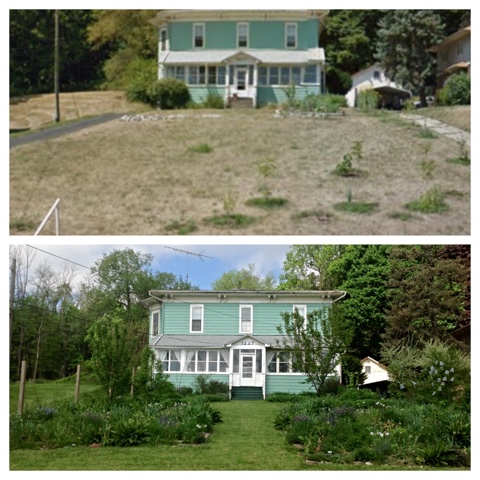
The picture above shows our first steps at Lillie House. We began with 3 strategies at once. 

First, we created our first "zone 1" garden area, a guild right outside our front door, with a few favorite annual vegetables, and a collection of important perennials, including our favorite Egyptian walking onions. We planned out this guild in detail, prepared the site, contoured the beds to collect water, dug a trench to collect water from our down spouts, planted and mulched. Since then, this part of our yard has required almost no additional maintenance, while it has provided much of the plant material we've used to transform the rest of our property. 

At the same time, we planted out most of the woody perennials for our hedgerow. Slowly we added perennial vegetables to the hedgerow as we had time and plants to do so. We guilded each tree with garlic, walking onions, and a few other spreading perennials, to help reduce the work. We would "spot mulch" parts of the hedgerow as necessary, with woodchips or whatever else we had on hand. Jerusalem artichokes filled in the spaces between the plants in the second year, and since then, it has continued to grow and mature with just small inputs and additions. 

In our backyard, we planted out our major "over-story" trees in the first Spring. If necessary, we could have waited, but it's always good to get trees in early if possible. We transplated some blackberries and black raspberries and let them go to town! They have provided a major yield in the early years, and they've died back as the system has filled in, which is what they generally do in nature, as "pioneer species." 


In our backyard, we planned out our main permanent paths and we stopped mowing everything else. The second you stop mowing and spraying lawn, nature gets right to work enriching your soil and your yard, and you have more time to help her out. We've slowly added to each little guild, replacing "weeds" that had done their hard work on the soil for us, with species that were of more value to humans and wildlife. Thistles became cardoon. Dock became various garden sorrels. 

"No till" potatoes became a common transitional plant, as it's easy as pie to "chop and drop" a bit of unmown grass and "weeds," plop an extra potato down on top of them and add some compost and more mulch on top of that. Many of these patches have perennialized, giving us potatoes for many years, while creating fantastic garden soil. I can create a new potato patch in about a minute, that will give potatos for years. 

And at each step, it has been as important to ask, as "Natural Farming" author Masanobu Fukuoka did, "what can I NOT do?" as it has been to "get stuff done." 

If you over-do the "inputs" as you create your garden, you tend to create systems that require continued intervention and work. But if you let nature do as much prep work as possible, you tend to end up with systems that take good care of themselves. 

Working in that way, with nature, things will transform much more quickly than you'd believe. 

All it takes is to get started. 


Wednesday, May 11, 2016

Tour/Introduction to Permaculture, Saturday May 21st 3:00 PM


Come see Lillie House! Get a tour of our Permaculture Forest Gardens at Lillie House, along with our Introduction to Permaculture class. It's a chance to observe a variety of classic Permaculture techniques, polycultures and guilds, learn about the classic Permaculture water-harvesting strategies, and discover a variety of perennial crops like Turkish rocket, sweet rocket, a dozen varieties of perennial alliums, and a huge variety of beautiful perennial edible landscaping plants. 


Tours are free, but print materials and resources are available for a suggested $12 donation. 


Space in our urban garden is limited, so please reserve a spot by emailing me at lillie.house.kzoo (at) gmail.com.


We hope to see you then!


Tuesday, May 3, 2016

April Harvest Totals


April was a good month in the forest garden. Since the begining of the month, something from the garden has been on the plate every day and practically every meal at home. We've purchased almost no vegetables, except for a few pounds of potatoes, with most of our produce coming from the garden. Of course, we're still addicted to oranges and bananas, drenched in oil and shipped from far-off lands, but our first fruit yields will start coming in soon. In a few years time, we'll hopefully be producing enough storage fruit to keep us through to June. 


Our total time spent doing gardening work was about 20 hours, and our yield was a minimum value of $1,200, earning us an hourly rate of over $50/hour for our work, and really, really cheap "prices" on amazing organic produce. And these are often "bargain basement" idealized prices, sometimes 1/10th of market rate for similar items, such as on the sunchokes, roses, and potted plants. At actual local market prices, that rate would probably be way higher, close to $100/hour, but since I haven't actually got a market for those products, I've used much lower numbers. 

(Dense edible ground covers of self-sown annuals and perennials is up and ready before most people have put in their gardens. Imagine if we had a market for all the food you see in this picture!) 

Money for your time - this is where forest gardening really shines, compared to conventional gardening, where my time would probably be worth $3/hour and produce is extremely expensive, with actual prices for garden produce being comparable to the famous $30/tomato one journalist who tracked his garden inputs grew. It's just nearly impossible to grow food for less than market rate using conventional gardening, making normal gardening an expensive hobby.    


April yields:

16 lbs spring root veggie blend, jerusalem artichokes, evening primrose root, carrots, parsnips, potatoes, crosnes, daylily tubers. 
6 Mixed Greens Salads
7 packages spring green onions
1 packages chives
5 bulbs spring garlic, with greens
6 lbs of spring greens 
5 boxes arugula
1 box Mache
2 small fennel bulbs
1 lovage stalk
2 dozen large asparagus spears
20+ kale broccolis 
2 dozen+ fresh winecap mushrooms

1 Bouquet Daffodils


Approx Minimum value: $200

plants:
20 blackberry
10 elderberry
3 rosa rugosa rubra and Frau 
10 anise hyssop
10 monarda
10 Oregano
10 yarrow
2 chives
10 mint
5 chocolate mint
7 turkish rocket
7 brown-eyed susan
4 bellfowers
2 dozen sunchokes 

Aprox minimum value: $1,000 April 26th. 

Total Minimum Product Value: $1,200


Maintenance work total 14 hrs 
2 mows, lawn-mower maintenance, potting and transplanting plants, bed preparation and spot mulching. Minor weeding. Bed edging. 

New infrastructure set-up work. 
16 hours.