Tuesday, September 2, 2014

Tour of Lillie House


Welcome to a virtual tour of our home, built by the Lillie Family sometime in the mid 1800s.


For many years now, we've been looking for a better way to live. For us, that meant a lot of what we'd read about in the "back to the land movement," more freedom, more simplicity, a lighter footprint and a deeper connection to our ecosystem. 
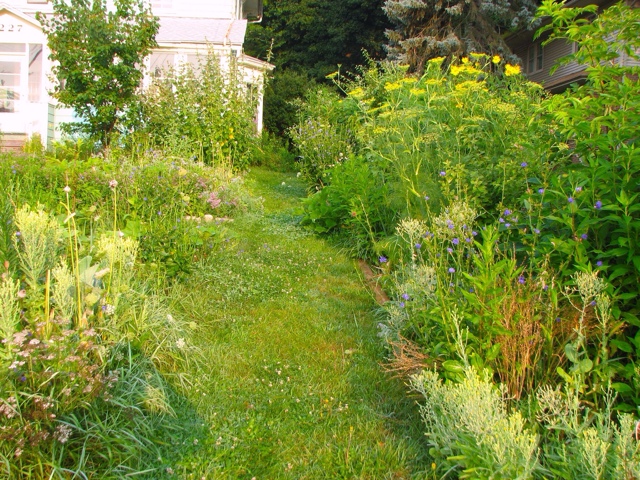

But coming from the suburbs, we missed the rich connection to culture, education, friends and community of living in the city. So we found an acre in a college town with a beautiful old house. 

In our three years here, we've started transforming the place through the tools of Permaculture design. You can learn all about Permaculture here.


Unlike the "hard work" gardens we had in the past, our garden works for us now.

We don't till, we don't spray or fertilize, we rarely weed, and hardly ever water.
Yet It provides us with fruit, herbs, vegetables, and salads virtually every day of the year, and a true relationship with nature and our food. 

Ecologically modeled "food forests," as well as edible hedgerows, and perennial guilds, conscript plants and wildlife into doing much of the work for us. 


And creating diversity not only saves on garden work, it brings in a wide variety of wildlife into our lives.


And Permaculture has taught us the value of using "restoration" to save money and time. Old houses can be the "easiest" houses for the same reason that they can be the 
greenest houses: materials.
They evolved in a time when things were made with quality materials meant to last, with designs intended to be maintained indefinitely and lived in comfortably with low energy inputs. 

On top of that, they were made in a time when everything was made to be beautiful. 


A strategy of finding the steps that yield the greatest return on investment has helped save us time and money we can return back to our projects, creating a "positive feedback loop." 

According to Consumers Energy, simple, low-cost steps have made our big old victorian home one of the top 15% "most energy efficient homes" in the city. 


And, of course, all of this has allowed us to easily transform an empty city lot into a place of beauty and plenty. 


Thursday, June 26, 2014

Black Raspberry Season is Here!


I've eaten my first half-dozen black raspberries of the year. I'm always surprised by how loaded with flavor these berries are, compared to raspberries from store. 

This reminds me of the wild patch we used to forage from when we lived in Illinois. The berries there grew in a thicket along a black-top bike trail, with no other maintainance than the deer and bikers would give then in a brief pass. But we would go home with 5 or 6 quarts each visit, which most years was at least a couple. And each time, we were never alone. There were always new people there filling bags and tupperware containers full of some of the best raspberries I've ever eaten. More-over, we'd always pick some elderflowers for fritters, to have with some raspberry syrup! Later in the year, it was the elderberries themselves. Not to mention the mulberries growing over the black raspberries....

I've read many times that a "low input, high output" food system is an un-achievable "holy grail" of agriculture. We can use lots of inputs, fossil fuels, labor, fertilizer... and get a big yield back. Or, we can use few inputs, and get little back. But, they say that low input, high output is impossible! 
And here we had a NO INPUT high output system... just waiting for anyone who passed by...

I

I


Monday, June 23, 2014

Best Water Storage Device Ever!


This is a picture of our favorite Permaculture water storage device at Lillie House. 

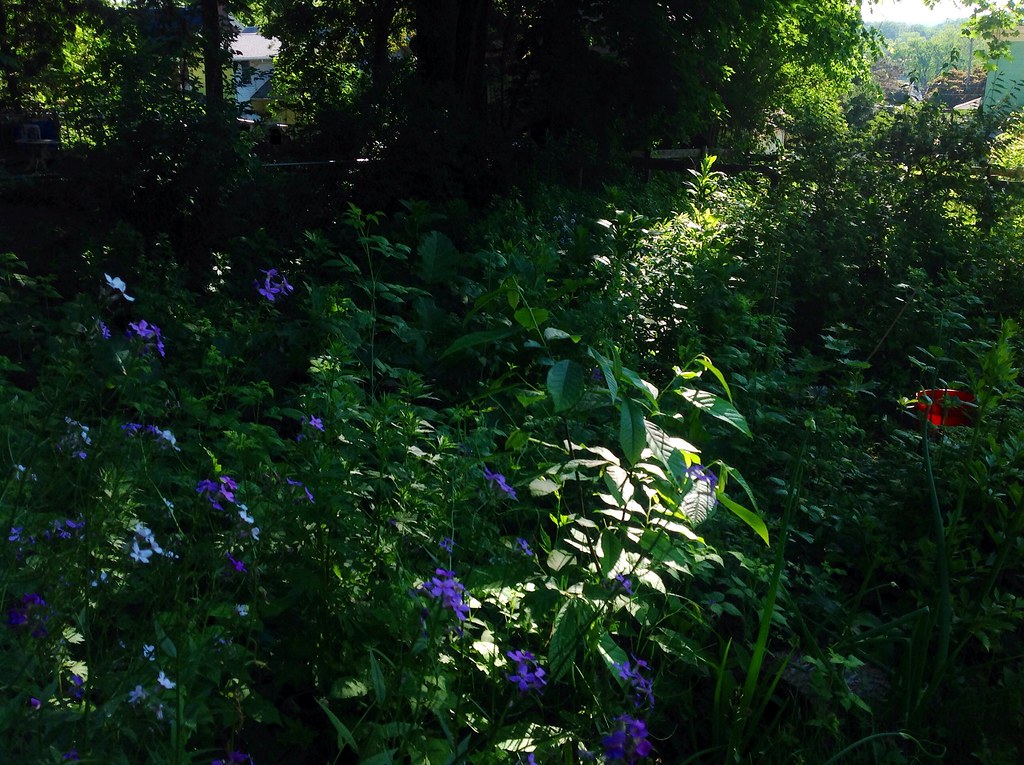
You just have to see the forest for the trees and there it is--A forest! Or more precisely, a forested hilltop. 


Those of us in Gardening and Permaculture circles know the best place to store water isn't in rain barrels or containers, it's in the ground. A rain barrel will hold 50 gallons of water and massive sisterns can hold maybe 1,000 gallons.  

A single storm in our climate can rain down THOUSANDS of gallons of water on an average roof top. 

You'd need an awful lot of barrels to catch all that water. 

Meanwhile, forests catch and infiltrate nearly 100% of the water that falls on them. The roots and fungi of a forest floor, topped with course woody debris, also form a great a natural irrigation system, storing and distributing water (and nutrients) to plants that need it. The water then moves slowly down-hill feeding and fertilizing the plants below, which is where we have conveniently placed our irrigation-free main crop beds, which are shaped to harvest water, and are deeply mulched and linned with fallen wood logs to harbor fungi. 

At Lillie House, we've planned both of our water-intensive garden systems to be down-hill from forest areas. In our back yard, a natural old forest feeds a section of food forest with "passive swales" (debris placed on contour to slow water, accumulate silt and run-off debris and eventually form small swales without ever digging.) In turn, that food forest feeds a set of water-harvesting, deep mulched garden beds designed for "dry farming." Here, we have drought-tolerant perennial plants and self-seeding annuals as the back-bone for no-dig annual polyculture crops that taste best with a little drought. Dry weather actually concentrates the flavors of crops like tomatoes, peppers, corn, melons and squash. The combination of appropriate crops, deep mulches, thick plantings that shade the soil, well-timed planting (before rains,) protection from wind, and a rich underground resevoir of water and fertility provided by forest ecology offer up a comprehensive water strategy that mean we never have to irrigate these crops. 


We didn't have a forest in our front yard, so we planted one! Again, we planned a food forest uphill of our front yard intensive crop beds, for plants we use and visit every day, like salad crops and herbs. Here's where we used a few tiny, appropriatelly-sized swales, fed by our down-spouts, to help the forest get established. 


But ultimately, as these food forests establish, we can count on nature chipping in to help us water, feed and mulch these intensive beds for us. 

So, while swales and elaborate earth-works can be helpful at times, it's good to remember that the best and easiest water-harvesting and storage device is the one nature herself uses, forests! 


Friday, June 6, 2014

Tips on easy gardening

I just updated our flickr stream with a set of pictures about creating super easy gardens with little work by using fortress plantings, polycultures and no dig beds. You can check it out here https://www.flickr.com/photos/35817162@N00/


Wednesday, May 28, 2014

Spring 2014...

Well... it's been a busy Spring. To see what's been going on in our garden, you can check out our flickr account here: http://www.flickr.com/photos/35817162@N00/

After taking a position as a Program Manager for the Douglas Market at Fair Food Matters, I've been immersed even deeper into the problems of our unsustainable and inequitable food system.

I'm learning more and more about what terrific people our farmers are and how hard it is to make a living doing their good work. I've been busy talking to folks about how the Douglass Market could play a role in making that a little bit easier for a few of them while at the same time providing access to food in a food desert and promoting food sovereignty for the Northside Neighborhood and surrounding communities.

Meanwhile, the garden moves along without me....

Many of our plantings at this point came back in the spring and provided great meals as soon as the snow melted.


At this point, there's enough biomass being produced to fight back the grass with a quick "chop and drop" spot mulching. A quick "cut" of some of our large plants produces lots of mulch to smother weeds and protect our plants.

What a great, busy Spring it's been.