Wednesday, May 25, 2016

Beginning


There's nothing more powerful than beginning. In a few short years, you'll look back and be amazed by what you've accomplished. 

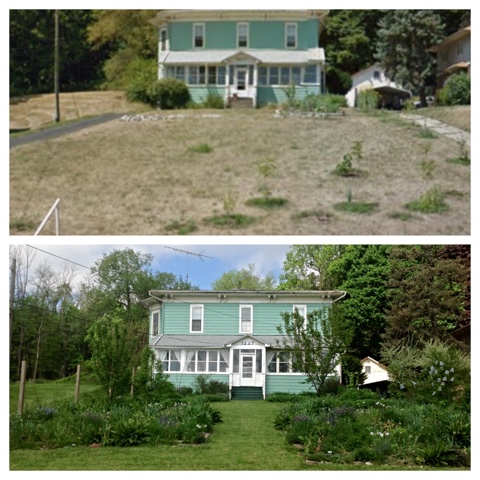
The picture above shows our first steps at Lillie House. We began with 3 strategies at once. 

First, we created our first "zone 1" garden area, a guild right outside our front door, with a few favorite annual vegetables, and a collection of important perennials, including our favorite Egyptian walking onions. We planned out this guild in detail, prepared the site, contoured the beds to collect water, dug a trench to collect water from our down spouts, planted and mulched. Since then, this part of our yard has required almost no additional maintenance, while it has provided much of the plant material we've used to transform the rest of our property. 

At the same time, we planted out most of the woody perennials for our hedgerow. Slowly we added perennial vegetables to the hedgerow as we had time and plants to do so. We guilded each tree with garlic, walking onions, and a few other spreading perennials, to help reduce the work. We would "spot mulch" parts of the hedgerow as necessary, with woodchips or whatever else we had on hand. Jerusalem artichokes filled in the spaces between the plants in the second year, and since then, it has continued to grow and mature with just small inputs and additions. 

In our backyard, we planted out our major "over-story" trees in the first Spring. If necessary, we could have waited, but it's always good to get trees in early if possible. We transplated some blackberries and black raspberries and let them go to town! They have provided a major yield in the early years, and they've died back as the system has filled in, which is what they generally do in nature, as "pioneer species." 


In our backyard, we planned out our main permanent paths and we stopped mowing everything else. The second you stop mowing and spraying lawn, nature gets right to work enriching your soil and your yard, and you have more time to help her out. We've slowly added to each little guild, replacing "weeds" that had done their hard work on the soil for us, with species that were of more value to humans and wildlife. Thistles became cardoon. Dock became various garden sorrels. 

"No till" potatoes became a common transitional plant, as it's easy as pie to "chop and drop" a bit of unmown grass and "weeds," plop an extra potato down on top of them and add some compost and more mulch on top of that. Many of these patches have perennialized, giving us potatoes for many years, while creating fantastic garden soil. I can create a new potato patch in about a minute, that will give potatos for years. 

And at each step, it has been as important to ask, as "Natural Farming" author Masanobu Fukuoka did, "what can I NOT do?" as it has been to "get stuff done." 

If you over-do the "inputs" as you create your garden, you tend to create systems that require continued intervention and work. But if you let nature do as much prep work as possible, you tend to end up with systems that take good care of themselves. 

Working in that way, with nature, things will transform much more quickly than you'd believe. 

All it takes is to get started. 


Wednesday, May 11, 2016

Tour/Introduction to Permaculture, Saturday May 21st 3:00 PM


Come see Lillie House! Get a tour of our Permaculture Forest Gardens at Lillie House, along with our Introduction to Permaculture class. It's a chance to observe a variety of classic Permaculture techniques, polycultures and guilds, learn about the classic Permaculture water-harvesting strategies, and discover a variety of perennial crops like Turkish rocket, sweet rocket, a dozen varieties of perennial alliums, and a huge variety of beautiful perennial edible landscaping plants. 


Tours are free, but print materials and resources are available for a suggested $12 donation. 


Space in our urban garden is limited, so please reserve a spot by emailing me at lillie.house.kzoo (at) gmail.com.


We hope to see you then!


Tuesday, May 3, 2016

April Harvest Totals


April was a good month in the forest garden. Since the begining of the month, something from the garden has been on the plate every day and practically every meal at home. We've purchased almost no vegetables, except for a few pounds of potatoes, with most of our produce coming from the garden. Of course, we're still addicted to oranges and bananas, drenched in oil and shipped from far-off lands, but our first fruit yields will start coming in soon. In a few years time, we'll hopefully be producing enough storage fruit to keep us through to June. 


Our total time spent doing gardening work was about 20 hours, and our yield was a minimum value of $1,200, earning us an hourly rate of over $50/hour for our work, and really, really cheap "prices" on amazing organic produce. And these are often "bargain basement" idealized prices, sometimes 1/10th of market rate for similar items, such as on the sunchokes, roses, and potted plants. At actual local market prices, that rate would probably be way higher, close to $100/hour, but since I haven't actually got a market for those products, I've used much lower numbers. 

(Dense edible ground covers of self-sown annuals and perennials is up and ready before most people have put in their gardens. Imagine if we had a market for all the food you see in this picture!) 

Money for your time - this is where forest gardening really shines, compared to conventional gardening, where my time would probably be worth $3/hour and produce is extremely expensive, with actual prices for garden produce being comparable to the famous $30/tomato one journalist who tracked his garden inputs grew. It's just nearly impossible to grow food for less than market rate using conventional gardening, making normal gardening an expensive hobby.    


April yields:

16 lbs spring root veggie blend, jerusalem artichokes, evening primrose root, carrots, parsnips, potatoes, crosnes, daylily tubers. 
6 Mixed Greens Salads
7 packages spring green onions
1 packages chives
5 bulbs spring garlic, with greens
6 lbs of spring greens 
5 boxes arugula
1 box Mache
2 small fennel bulbs
1 lovage stalk
2 dozen large asparagus spears
20+ kale broccolis 
2 dozen+ fresh winecap mushrooms

1 Bouquet Daffodils


Approx Minimum value: $200

plants:
20 blackberry
10 elderberry
3 rosa rugosa rubra and Frau 
10 anise hyssop
10 monarda
10 Oregano
10 yarrow
2 chives
10 mint
5 chocolate mint
7 turkish rocket
7 brown-eyed susan
4 bellfowers
2 dozen sunchokes 

Aprox minimum value: $1,000 April 26th. 

Total Minimum Product Value: $1,200


Maintenance work total 14 hrs 
2 mows, lawn-mower maintenance, potting and transplanting plants, bed preparation and spot mulching. Minor weeding. Bed edging. 

New infrastructure set-up work. 
16 hours. 


Tuesday, April 26, 2016

Deer-Proof Permaculture (With Plant Lists!)


While our garden supplies a variety of 300 species of fruit, nuts and vegetables, many of which are choice delicacies rarely found even in expensive health-food stores, the greatest yield we obtain from our Permaculture garden is our interaction with nature. We love watching the fleet of deer, turkeys, a huge variety of birds, groundhogs, squirrels, voles, moles, shrews, deermice, rabbits, toads, snakes, fox, owls, bats, etc. and a micro-managerie of colorful, whirling invertebrates who are all frequent guests in our garden.

"Our garden." 

A uniquely human but certainly in-humane concept. 

Really, there are quite a few individuals, friends, we've come to recognize as co-habiting, co-tending and even co-creating this habitat with us. Who are we to say its "ours?" 

Only us modern "civilized" humans would be so freakishly controlling and neurotic as to attempt to lay claim to a bit of land and only allow select individuals to serve our needs exclusively, strictly omitting all other species from meeting their needs off our "property." 

Why must we battle so with our non-human cousins? 

This struggle only makes us poorer, when we would be much better served by a diverse and healthy ecosystem, filled with willing volunteers from a wide swath of species, all making "our property" richer, more diverse, healthy and abundant. 

We don't need Ecologists to tell us that diverse ecosystems are healthier and more productive, and that they grow more healthy, fertile, and rich over time as they catch each drop of energy and store it in a network of species. We need only walk into a forest and compare it to our drab, needy, sick human landscapes.  


Permaculture is a system of design based on three ethics. The first ethic is "care for the earth." A Permaculture garden aims to be more than a vegetable garden, it's also an orchard, a medicinal garden, a pleasure garden, a recreation space, a garden for crafts and building materials, fuel for heat, and most importantly, a wildlife garden - all rolled into one. Most importantly, it's a way to "care for the earth." 

But Permaculture's second ethic is "care for people," and we want a garden that will obtain a good yield for its human stewards, rewarding and incentivising good earth care. We recognize that there's a place for everything, including deer - and that place probably isn't your Hosta garden. So, this article will look at how we can design a system with a place for wildlife, including the hungry, vegetable-eating kind like deer and rabbits. 


--------------------------------------------

"Pest" Vision

The standard American garden is a deer and rabbit paradise. 

First, it's typically way out in the backyard somewheres, far from where they're likely to run into those obnoxious, angry two-legged animals who are always yelling and chasing everybody else away. I mean, WE HUMANS hardly ever go out there, and we haven't even marked it as our territory, so obviously we didn't put it out there for us!

Next, it's so neat and tidy, where everything's easy to see and find and all their favorite plants are placed together in a nice neat rows like a buffet. There are no weeds or anything in the way that might confuse them. No spots where predators might be hiding to be warry of. Usually there's a clear line of sight to the house to see if the grumpy humans come out. 

And there's no place else like it! It's a unique, distinctive environment that's set aside from everything else in their habitat - something that's sure to stick in their minds and attract a lot of interest and attention. It's so obviously a special place JUST for good deer and bunny food. 

They're sooooooo happy you made it just for them!

And so long as we do things like that, we should just plain expect deer, rabbits, etc. are going to be spending some Q.T. in our gardens. Really, we're just being silly if we don't. 

 (Wild beastie, Mu, sleeping by my leg while I write.)

--------------------------------------------

Get Zoned Out

One of Permaculture's most important design concepts is arranging land and uses into "zones" based on how often each space is naturally visited and how much energy each takes to work. Basically, the uses that require the most human energy and attention, should go in the places that we naturally visit most often. 

Duh, right?

For example, the garden plants that require daily attention could be placed right next to the door you use every day when you go to work so that you naturally see those plants without having to make a special, separate trip. Meanwhile, plants that only require weekly or monthly visits can be placed together in locations you naturally visit once a week or once a month. Now, you don't have to waste time or energy on any special trips.  

Brilliant!

This "cares for the earth" because it replaces fossil fuel energy like tilling and chemical interventions like spraying with easy human energy like daily hand-weeding and "spot mulching" (placing a little mulch to smother out emerging weeds.)  And it "cares for people" because it naturally saves us time and energy and makes life easier. 

(Sketch of zones for Lillie House)

But the idea of "zones" is also Permaculture's first line of defense against "pests and weeds," including deer and rabbits. 

Actually, this was the MAIN strategy for dealing with pests and weeds in almost every human culture throughout history right up until the 1920s/30s, when the US government enacted a policy of drastic agricultural reform intended to evict farmers off their family farms to create an army of poor and needy, low-cost labor for urban industrialization. Since then, we've taught governments around the world to commit the same crime against their citizenry. In my opinion, this was probably the cause of the single greatest loss of technology, wisdom and knowledge in human history. But I digress....

Here's how that forgotten common-sense technology used to work:

Zone 1-2: Close to the home, the main outdoor living area. 


Look familiar? This is the classic homestead pattern found world-wide prior to The Great Stupiding of the "green agricultural revolution." 

How about this one: 


First, this area closest to the home, with the most human traffic is naturally suspect to wildlife. It's the riskiest place to visit for a snack. But it's also a place where a quick sprinkle of cayenne pepper or garlic tea can help protect nibbled plants. Since critters are naturally warry of this zone, anyway, extra deterrents go a long way, and a plant that unreliably smells and tastes bad isn't worth the risk. 

(A Zone 1-2 garden guild including sensative plants.)

Finally, if you're going to fence or hedge an area, zone 1 is the easiest place to do it. A small fenced or hedged area is all you need to grow all the crops that really require protection from deer and rabbits, and the hedge can itself be a multi-species, food-producing area.

(Colorful edible hedgerow surroundsd   our zone 1-2 garden)

What goes here? Everything you'd complain about getting eaten by rabbits or deer. Basically, if we're going to be neurotic humans trying to exclude other species, it's going to go better if we keep that strategy to as small a space as possible. 

What additional control measures do you use? Sprays of comfrey or nettle tea with garlic or cayenne pepper added. Powdered cayenne pepper. Not much else should be necessary. 

Zone 3-4: Everything beyond the immediate "home garden" area. Areas that will receive maintenance once per week or less.

(A "wild" natural food forest of deer-friendly species at a church. No "pest-deterrent" being used on this bike-trail through deer country, but it yields a large quantity and variety of fruits all season long. )

Typically, zone 3 refers to crop areas, especially market crops and "calorie" crops intended to provide carbohydrates. Zone 4 refers to managed "semi-wild" areas where crops are grown in forests or areas returning to forests ("agriforest" systems.)

This also includes any "public garden" areas, business, workplace, churches and other public landscapes.

The key is a shift in perspective: in these zones, the wildlife are your greatest asset, your aids and teachers. They are there to help tend your land, fertilize, provide pest and weed control through increasing diversity, and prune your plants for you. 

They'll sure teach you about which plants are truly "wildlife proof!"

They also teach you the vital lost knowledge of what it means to be a member of an ecosystem with a direct natural relationship with nature - deep wisdom that almost all of our human ancestors treasured, but that is extremely rare today. 

You pay for these valuable services by allowing these non-human neighbors to "make a living" off of a small share of "your" crops.

In these zones there is only one tool for dealing with wildlife, to work together to evolve a STABILIZED   ecology that integrates wildlife interactions and productivity - a complete ecosystem, where we are just one point in the web of life. 

(Another wild beastie lurking in its natural habitat.)

To co-create your deer-stable agro-ecology, what you plant is of utmost importance and while I can give you some pointers based on research and my own experience, your best teachers will be your wildlife. Remember, you're co-creating a stable ecology, and their feedback is vital. They'll teach you what kind of system will stabilize with them. 

The other key is high diversity. In any given year, if one crop or plant is harmed by over-predation, others will fill in the gaps. With enough diversity, overtime the system will "pop" in such a way that it will be productive to humans and integrate the positive interactions of wildlife. 

(Garden of Deer-Stable crops in our zone  3 area.)

There are two categories of plants that are most useful for these zones:

Deer/Rabbit TOLERANT Plants? WHA...?
These vigorous plants will get browsed by wildlife with relative frequency, but are almost never killed by them. They quickly recover and can grow and thrive despite ocassional browsing. 

I've often recommended these as deer-resistant plants and had people exclaim "but deer eat that at my place!" 

To which I respond: "did they KILL the plant?" 

"Well... no." 

Remember, the point isn't to completely exclude all other species. We're not trying to win a war against nature, what we want is a truce.

-------------------------------------

Here's a SHORT, INCOMPLETE LIST of FANTASIC DEER-TOLERANT FOOD PLANTS for a zone 3-4 Permaculture system or forest garden. These will probably work best in an integrated, decentralized polyculture system like a forest garden, rather than planted in clean, tidy, centralized monoculture deer-buffets of single plants. Most of these are often found on researched lists as "infrequently browsed" or "rarely browsed."  

Chestnut. This gets its very own mention, as the single most important Permaculture plant we can grow in the Great Lakes region, on any property where there's enough room for it. Chestnuts are an expensive, valuable commercial crop. But more importantly, they're our most important sustainable staple carbohydrate crop in cold climates, and our most viable option for growing calories outside of energy-intensive tilled fields of grains. For properties much larger than 3/4 of an acre, I always recommend trying to find a place to plant it. It will require caging as a deterrent as it gets established, but once mature, the tree will be impervious to wildlife assault. The crops will be shared with deer and other wildlife, but there will almost certainly be plenty left over for the humans to take advantage of. 

Perennial Veggies:
Rhubarb
Asparagus (pay extra for larger "crowns" in deer-prone areas to get them established.)
Turkish Rocket
Sweet Rocket
Blood-veined sorrel
French Sorrel (on the edge, sometimes this gets severely set back, but I've never seen it killed.)
Marshmallow
Garlic
Ground Nut (Apios Americana)
Hops
Oregano
Thyme
Smallage
Endive
Jerusalem artichokes

Annual crops for an "extensive," low-maintenance garden
Squash plants (Cover the seeds with Burdock leaves to protect them prior to germination.) I particularly recommend Long Island Cheese and Seminole pumpkins in our climate. 
Zucchini and summer squash
Tomatoes (deer often prune our vines, but wild varieties like Galapagos are worth a try.)
Potatoes (These are perennialized at our site and the deer almost never bother them.) 
Borage

Fruit:
Blackberry
Black raspberry 
Elderberry
Currants
Gooseberries
Strawberries
Aronia Berry
Highbush cranberry
Mulberry

Nuts:
Hazel
Black Walnut (buy varieties selected for easier cracking.)

(Allium unifolium kickin' it with walking onions and Turkish rocket, all holding their own against grasses and "weeds" in a heavily deer and rabbit area in our zone 3.)

Deer-RESISTANT Fruits and Vegetables:
These are the stronger category of plants that I have never once seen browsed, even with our overstock urban deer population. Even if your deer get a little crazy some night and try a nibble or two, they're almost certainly not going to ravage your entire populations of these. Our zone 3-4 garden is overrun with deer, rabbits, groundhogs and so on, but I have never seen these touched:

Veggies:
Egyptian walking onions
Welsh onions
Chives
Garlic Chives
Single-leaf onion
Ramps
Claytonia Virginica
Cammas (great vegetable!)
Lovage
Potatoes (these are perennialized in the sunnier areas of our zone 3/4 garden 
Daylily
Ostrich fern
Milkweed
Stinging nettle

Fruit:
Goumi
Paw paw
Rugosa roses

And finally, here's a list of plants to experiment with. These are still being tested here, but have shown good potential of being deterrent/resistant thus far:

Veggies:
Celery
Wild tomatoes
Ground cherries
Cardoon

Fruit:
Quince
Medlar

And that's just a start. There are more fruits and vegetables that can be grown in such a wildlife-friendly garden. Beyond this, there are a whole great variety of HIGH VALUE deer-stable crops for a for-profit system, if you expand into plant stock and medicinal herbs that can really add value to a Agriforest.

Which brings us to Permaculture's third ethic: "Fair Share." These days, it's frequently also expressed as "re-invest the surplus" or as it was originally stated: observe and respect natural limits. Really, these are all the same. If we can produce a system that values the diversity of plants and wildlife, and mindfully "reinvest" in our non-human partners, then this abundant, self-maintaining system will provide for us better than any corn field ever could. But that requires us to step back, observe limits, and make some room in this world for our non-human cousins. 

-------------------------------------

All of the plants mentioned in this post are, conveniently enough, available through our Lillie House Community Supported Permaculture program, where we help you create your own Permaculture design, supply you with plants and teach about Permaculture gardening techniques. If that sounds interesting, you can learn more here: 

https://lilliehousekzoo.wordpress.com/the-basic-home-garden-membership/


Friday, April 22, 2016

Selecting Trees for a Forest Garden: What to plant and How Many


These days, the "new" wisdom is that - 100, 400, 1,000 - "you can't plant too many fruit trees!"

Not surprisingly, this advice most often gets repeated by nursery businesses that sell fruit trees. And as a guy with a small nursery business, sure, I agree with it, but I add a HUGE caveat: it depends on what kind of tree you're planting.

The problem is fruit trees are work.


Work, work, work!


If you buy a bunch of fruit trees, you're buying yourself a bunch of work! 


So I break down trees into how much work -time, energy and care - they require to produce a yield: "Intensive" trees, that require a lot of work, "Extensive," which produce fruit with almost no care, and "Semi-Intensive" that are somewhere in the middle. 


The important thing here is the "Law of Diminishing Marginal Utility." Up to a point, having more fruit is GREAT!


But after that point, the value of each fruit diminishes as you add more. One apple tree can provide a family with most of the fresh apples they'll eat, plus some for gifts, trade with neighbors and cooking or storing. Having a few apple trees means the family will have to spend some serious time doing orchard work, and probably have to use chemical means to maintain their fruit, but if they work hard they can be completely self-sufficient on fruit. Beyond that, they'll have to put time and energy into an orchard business, or else they'll have a massive mess of rotting apples and wasps, create disease and pest problems for their neighbors. Still more trees? Now you HAVE to use chemicals, manage a labor force, advertise and market your apples, find shipping, purchase insurance for crop failures.... Still MORE? Now there's a glut in the market and each new apple - and the time you spent growing it - is worth less and less. 


Looking at historic sources, old-time homesteaders understood this very well! It was the standard recommendation that - unless you wanted to run a full-time orchard - each family had a few fruit trees, depending on what worked best in the region. Beyond that, more fruit meant more work with less and less to show for it! In our region it was common for each family to have a workhorse apple, usually a cooker/keeper, possibly a pear, or maybe a cherry or two. A few berry bushes rounded out the homestead fruit selection. This was the standard in England, too, where allotments and cottage gardens typically had a plum or cooking apple like the Bramley. Actually, this pattern looks very similar world wide.

But not all fruit and nut trees are equal in this regard. Some take more work than others. So, while a few too many "INTENSIVE" trees, like apples, can become a menace, it really is almost impossible to have too many "EXTENSIVE" trees like service berries. They produce wonderful fruit that's rarely buggy with almost no work. And if you don't harvest them, the birds will, so you won't end up with a stinky rotting mound of wasp food making the neighbors mad.

Keeping this in mind, a well-planned homestead will "bulk up" on "extensive" trees that will provide great benefits but won't become a burden, and have just a few, well-chosen "intensive" trees.


After reviewing historic and modern recommendations, here's how I'd break these down:

Intensive Fruit Trees (my recommendation, 0 - 2 per family, unless you're operating a pro orchard.)


First, you'll notice that I expanded beyond trees to include all fruiting woody perennials, because they'll give you fruit and add to your work, just like a tree! So, it's good to consider them together. 


Only plant these if you really love the fruit and you're going to make a commitment to work for it. Not to be dogmatic or anything, but for most homes and home-owners they're more trouble than they're worth. If you really love them, go for it!


But let's face it, there are probably over a dozen apples and half dozen pear trees within a mile of your home that never get picked. 


Since forest gardens rely on a no-spray regimen for their health and pest prevention, in the Great Lakes region, plan on bagging fruit from these trees to protect them from pests, by putting paper bags or "wedding favor" bags on the young fruit after pollination. They will also require pruning and other maintenance and may experience disease issues. Generally, I look for varieties selected for "no spray" or organic treatment. I also recommend dwarf varieties to make bagging and picking fruit easier.
Apples
European pears
Plums
Peaches
Apricots
Cherries


Semi-intensive (1- 4)


These options provide big, sweet, valuable fruit without such a problem with bugs. It's possible to get good, clean fruit without spraying or bagging. The biggest work problem with these after establishment is harvesting, and storage, which can become a burden.
Asian pears
Jujube (zone 7 and up)
Persimmon (zone 7 and up) Nakita's gift persimmon (the only persimmon I can currently recommend for home owners in lower zones or areas further from the equator.)
Cider and cooking apples and perry pears. (if you don't mind buggy fruit.)
Quince (A known fireblight host, Aromatnaya's the only variety I recommend.)


High-value Extensive (Feel free to plant lots of these.)
You almost can't plant too many of these. Where it seemed appropriate, I made recommendations to feed a family of 4. Having extra could provide the opportunity for trade, sales, or value-added products without creating a burden. These have almost 0 maintenance requirements and if they're not harvested they won't create a huge mess.
Blackberry (Plant in an "island" where it can be maintained by mowing.)
Raspberries (same as above.)
Goumi ( 4 bushes)
Elderberry (edible flowers and fruit.)
Serviceberry
Hardy kiwi (Issai only variety I recommend, 2 vines)
Paw paws (3 - 4 trees)
Honeyberry (5-10 bushes)
Strawberries (25 plants)
Aronia berries
Nanking cherry (4-5 bushes)
Medlar (1. Beautiful tree!)
Mulberry (Illinois Everbearing. 1 tree.)
Cornelian Cherry (2 bushes)
Hazelnut bushes (look for selected varieties that are blight resistant and have large nuts.

Lower value extensive

These add diversity to a system, but are not highly recommended.
Blueberry (valuable fruit, but yields suffer without spraying)
Passionfruit
Kousa dogwood (selected fruit varieties only, 1-2 trees. Beautiful.)
Sasafras
Linden (edible leaves)
Toon tree (edible leaves)
Staghorn sumac (edible "berries" for tea.)
Wild cherries

Recommended Nut trees
I made nuts their own category. Again, they are generally problem-free, but usually take work to process and store. They're also generally very large and only appropriate for the largest forest gardens. Gardens under an half-acre could look into duel-purpose trees, like Chinese Apricot, which produces an apricot and an almond all in one. Larger that an acre, large nut trees should probably part of your planting. I consider chestnuts particularly valuable for homesteaders and forest gardeners, not to mention cooks!


Black walnut. Valuable tree, difficult nuts to crack. Select easy-to-crack varieties.
Carpathian walnuts.
Pecans.
Butternut.
Heartnut.
Hickory nuts. My favorites.
Chestnuts. Staple carb crop highly recommended for larger gardens or forest systems.
Korean pine.
Monkey puzzle tree. Generally too large and slow-to-mature to recommend for forest gardens. But very valuable future crop. 


What does it all mean?!?!

Well, putting that altogether, what would my recommendations for a tree planting look like?
Let's start with a typical suburban lot between 1/10th of an acre and 1/4 of an acre.
1 clump of 3 paw paws.
2 Asian pears.
1 mulberry, Nakita's gift persimmon or medlar
MAYBE 1 dwarf multi-graft apple or other intensive fruit tree.
5 or 6 "extensive" fruit bushes.

That collection would look very much like the 1/10th acre Holyoke Edible Forest Garden, one of the most famous forest gardens in America. It's interesting to note that a few years ago they blogged about removing all their "Intensive" fruits like apples and cherries, saying "it's not worth it!" and replaced them with asian pears, paw paws and persimmons.


(www.foodforestfarm.com)


With more land, I might add a few more "intensive" or "semi-intensive" trees, but mostly, I'd look to add more "extensives." Over a half-acre I would probably add large nut tree or two, and I'd fill in the understory with appropriate shade tolerant "extensives" like paw paw, elder and serviceberry.

Much beyond an acre, or possibly a few acres, we've really outgrown the idea of a "forest garden" and into the concepts of "managed forest," "agriforest systems" or Permaculture orchards. At that scale, keeping in mind the Permaculture concept of "zones," I would create a small garden just as above, and then for the rest of the land, I'd look to create a commercial orchard of some kind or an extensive forest of "extensive" fruit and nut trees with high-value wood.

Again, this arrangement describes and reflects much of the historical practices of land management prior to the age where fossil energy transformed our landscapes by making environmentally degrading practices cheap and easy. What worked well for people in the days prior to cheap energy is likely to work well for those of us who wish to lower our environmental impact, save money, and grow our food organically.

And remember, Permaculture starts with the ethic "people care," so if your planting creates a bunch of work for you, it's' not "people care," and it's not Permaculture!